63. After Completion
既濟 · Jì Jì · Dopo il Compimento · lines from the bottom: 101010
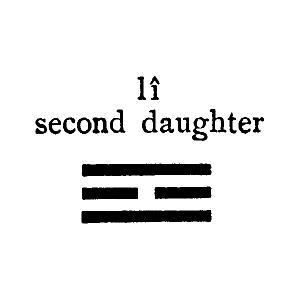
The two trigrams

The Judgement
After Completion is the moment when the undertaking has succeeded: the river has been crossed, the crisis is over, the goal is reached. Every line of the hexagram is in its correct place, and the ancient text promises progress and success, but in small matters; it will be advantageous to be firm and correct. And then the sentence that weighs: there has been good fortune at the beginning, but there may be disorder at the end. Legge explains it this way: the ship of state has come into port, and now the new order must be consolidated without noise, without clamour, always keeping in mind the instability of human affairs. If you have just obtained something important, a job, a house, a degree, the end of a hard period, this hexagram tells you: good, but do not relax completely. It is precisely after success that details are neglected and the most costly mistakes are made. The practical advice is to devote the next weeks to maintenance: check the accounts, renew the deadlines, tend the relationships that helped you. Completion is not an end, it is the start of a new round.
Source: James Legge, The Yî King (Sacred Books of the East, vol. XVI) (1882) · read the original passage
The Image
Fire below and water above: each element is in its right place and the two work together, like a pot on the stove. The wise person, says the image, thinks of the evil that may come and guards against it beforehand. For you it is a call to prevention while all is well: it is now, not during the storm, that the roof gets checked. Make a list of the weak points in your situation, a contract about to expire, an expense that is growing, a relationship a little neglected, and fix the first one within the week. Whoever prepares in calm crosses the crisis lightly.
Source: James Legge, The Yî King (Sacred Books of the East, vol. XVI) (1882) · read the original passage
The six lines
First line
First line: you are like a driver who drags back his wheel, or like the fox that has wet its tail and does not try the river again. There is no error. Right after a success comes the time to stop, to hush all movement for a season. If you have just closed a deal, an exam, a move, do not throw yourself at once into the next: brake, catch your breath, let the tail dry. Braking now is not weakness, it is the only way not to waste what you have just won.
Source: James Legge, The Yî King (Sacred Books of the East, vol. XVI) (1882) · read the original passage
Second line
Second line: a woman has lost the screen of her carriage, what kept her sheltered from view. There is no need to run after it: in seven days she will find it. You have lost a protection, a support, perhaps a role that gave you security, and you feel exposed. The text tells you not to fret: your central and correct position is enough, and what is missing will return when the cycle has run its course. Do not chase, do not force. Stay reserved, do your part, and wait for the right week.
Source: James Legge, The Yî King (Sacred Books of the East, vol. XVI) (1882) · read the original passage
Third line
Third line: king Kao Zung attacked the Demon region, and it took three years to subdue it. People of little worth should not be employed in such enterprises. It is the line of someone who, after completion, embarks on a long and wearing undertaking, perhaps a just one, but exhausting. If you are about to begin something big, a lawsuit, a renovation, a multi-year project, take it into account: it will be long, it will tire you, and you cannot entrust it to those who are not up to it. Choose your collaborators carefully, and prepare your strength for the distance.
Source: James Legge, The Yî King (Sacred Books of the East, vol. XVI) (1882) · read the original passage
Fourth line
Fourth line: you have rags ready against any leak in the boat, and you are on your guard all day long. You have entered the zone of water, that is of danger, and your attitude is the right one: foresee the trouble and keep at hand what is needed to plug it. There is a doubt keeping you awake, and it is no accident. If in the family, at work or in the accounts you feel something could give way, do not ignore the feeling: prepare a reserve fund, a plan B, an emergency contact. Vigilance today spares you the shipwreck tomorrow.
Source: James Legge, The Yî King (Sacred Books of the East, vol. XVI) (1882) · read the original passage
Fifth line
Fifth line: the neighbour in the east slaughters an ox, but it is not worth as much as the small spring sacrifice of the neighbour in the west, whose sincerity receives the blessing. A rich offering made superficially counts for less than a poor gesture made with the heart and at the right moment. If you are in a strong position and think it is enough to spend, give gifts, make grand gestures to set things right, in love or with colleagues, think again. What touches people is sincerity and timing. Do less, but make it real, and when it is truly needed.
Source: James Legge, The Yî King (Sacred Books of the East, vol. XVI) (1882) · read the original passage
Sixth line
Sixth line: even your head is under water. The position is perilous. It is the image of someone who, at the end of completion, pushes on with violence and imprudence, like a person attempting a ford and being plunged under. The commentary asks: how could such a state continue long? Be careful: if after a success you have kept daring, spending, expanding without looking, you are on the point of losing even your breath. This is not the moment for another step forward. Turn back, surface, and put your feet back on solid ground.