62. Preponderance of the Small
小過 · Xiǎo Guò · La Preponderanza del piccolo · lines from the bottom: 001100
The two trigrams
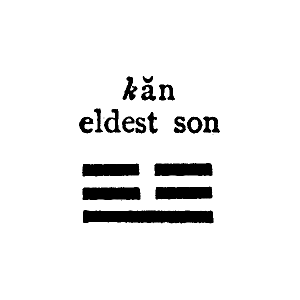
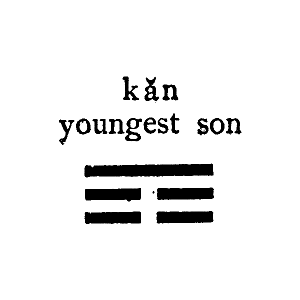
The Judgement
Preponderance of the Small is the moment when minute things count more than great ones. The ancient text promises progress and attainment, provided you are firm and correct; but it warns that what can be done in this period applies to small affairs, not great ones. Legge explains the sense: one may deviate from the usual procedure in what is form, convention, ceremony, never in what is substance and right; and even then with humility and care. The image is that of the notes coming down from a bird on the wing: to descend is better than to ascend, to stay near a branch where one can perch is better than to be lost in the sky. In this way, says the text, there will be great good fortune. If you feel the urge to make the big move, change everything, throw yourself into an ambitious venture, this hexagram tells you: not now. The practical advice is to aim lower and look after the details: answer that email, settle that account, make that courtesy call. Small things done well, now, will take you much further than grand gestures.
Source: James Legge, The Yî King (Sacred Books of the East, vol. XVI) (1882) · read the original passage
The Image
Thunder above the hill: the rumble born of the earth is loud, but by the time it reaches the top it has already faded. The wise person, says the image, in conduct exceeds in humility, in mourning exceeds in sorrow, in expenditure exceeds in economy. These are three excesses that harm no one. For you it is a concrete invitation: in this period, if you must err, err on the side of modesty, of sincere feeling, of thrift. This is not the moment to act big, to appear indifferent, to spend in order to impress. Cut one superfluous expense this week and notice how little you miss it.
Source: James Legge, The Yî King (Sacred Books of the East, vol. XVI) (1882) · read the original passage
The six lines
First line
First line: a bird flies and climbs ever higher, until the outcome is bad. It is the image of someone who, at the start of a road, is seized by the urge to go beyond, and no one holds them back; on the contrary, those above encourage them. Be careful: if you are about to throw yourself into something bigger than you, an expense, a commitment, a promise, because someone told you that you can make it, remember there is no way to avoid the fall if you are the one seeking it. Stay low, close to the branch.
Source: James Legge, The Yî King (Sacred Books of the East, vol. XVI) (1882) · read the original passage
Second line
Second line: you pass by your grandfather and meet your grandmother; you attempt nothing against the ruler, but meet him as his minister. There is no error. It is the line of measure in dealings with those above you: you do not claim to reach the top directly, you do not go over anyone's head, you stop at the level that is yours and present yourself with humility and loyalty. If at work or in the family you would like to skip the steps and speak with whoever decides, this line tells you to respect the distances: a minister does not overstep his place.
Source: James Legge, The Yî King (Sacred Books of the East, vol. XVI) (1882) · read the original passage
Third line
Third line: you take no extraordinary precautions against danger, and so some find the opportunity to assail and injure you. There will be misfortune. It is the line of someone too sure of their own strength who does not fear small enemies, who are however many and wait precisely for the moment you drop your guard. Be careful: an overlooked detail, an unread clause, an underestimated person can cost you dearly. This is not the time for bravado. Check, lock, protect, even if it feels excessive.
Source: James Legge, The Yî King (Sacred Books of the East, vol. XVI) (1882) · read the original passage
Fourth line
Fourth line: you fall into no error, you meet the demand of your situation without exceeding. But if you go forward there will be peril, and you must be cautious: there is no need to be using firmness all the time. You are strong, but in a position that asks you to temper your strength. If you have solved a problem with decision, do not turn that decision into a habit of hardness: there is a time to be firm and a time to let go. For now stay quiet, hold back, and do not push further.
Source: James Legge, The Yî King (Sacred Books of the East, vol. XVI) (1882) · read the original passage
Fifth line
Fifth line: dense clouds, but no rain, coming from our borders in the west. And the prince shoots his arrow and takes the bird in a cave. It is the line of someone who holds a high place but is weak, and cannot do great things: the rain does not come. But they can do small, concrete things, leaving the birds on the wing alone and aiming at the one within reach. If you are in a position of responsibility and feel that big results are not coming, do not force it: look for the small achievable goal, the nearby person to involve, and be content with that.
Source: James Legge, The Yî King (Sacred Books of the East, vol. XVI) (1882) · read the original passage
Sixth line
Sixth line: you do not meet the demand of the situation and you exceed your proper course; you are like a bird flying far aloft. There will be misfortune: it is what is called a case of calamity and self-inflicted injury. It is the extreme of the tendency to overdo, of someone who cannot hold back and grows used to domineering. Be careful: if you feel invincible, if you have stopped listening, if you are going too far in an argument, an expense, an ambition, stop before you hurt yourself. No one is pushing you: you are the one flying too high.