61. Inner Truth
中孚 · Zhōng Fú · La Verità interiore · lines from the bottom: 110011
The two trigrams

The Judgement
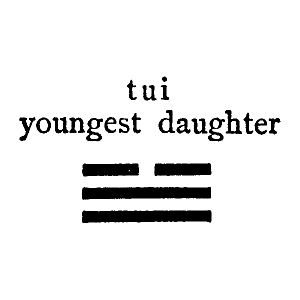
Inner Truth is the deepest sincerity, what Legge calls Inmost Sincerity: the highest quality of a person, which gives power over spirits, over other people and even over the rudest creatures. The ancient text says this sincerity moves even pigs and fish, that is the most closed and hardest people to reach, and leads to good fortune. It will be advantageous to cross the great stream, to face the difficult undertaking; and it will be advantageous to be firm and correct. The figure has two broken lines at the centre, the heart empty of ulterior motives, and whole lines on either side, the solidity of someone with nothing to hide. If you face a negotiation, a reconciliation, a person you cannot reach, a withdrawn child, a hostile colleague, a distant partner, this hexagram tells you the way is not strategy but transparency. The practical advice: tell the whole truth, calmly, even the uncomfortable part, and keep the promises you make. Whoever is sincere to the core can afford the hardest undertaking, because others follow.
Source: James Legge, The Yî King (Sacred Books of the East, vol. XVI) (1882) · read the original passage
The Image
The wind above the lake: it penetrates everywhere, shakes the grass of the plain, swirls through the valleys, melts the ice on deep waters. So is perfect sincerity. The wise person, says the image, deliberates carefully about cases of justice and delays the ultimate penalty. For you it means: before condemning someone, a colleague, a relative, a friend who let you down, try to understand truly, all the way. Do not close a door for good out of anger. Take time to examine the case, and always leave open the possibility that you are wrong.
Source: James Legge, The Yî King (Sacred Books of the East, vol. XVI) (1882) · read the original passage
The six lines
First line
First line: you rest in yourself. There will be good fortune. If you sought your security in someone else, you would not find rest. Sincerity, Legge explains, is wholly centred in itself: from there it comes and from there it draws its strength. Your purpose has not yet changed, and that is what protects you. If you are wondering whether to lean on a person, an approval, an outside guarantee to feel safe, the answer is: lean first on your own truth. Be clear with yourself about what you want, and the rest will follow.
Source: James Legge, The Yî King (Sacred Books of the East, vol. XVI) (1882) · read the original passage
Second line
Second line: the crane calls from her hidden retreat, and her young answer her. It is as if to say: I have a cup of good wine, and to hear the reply: I will share it with you. It is the loveliest line of the hexagram: the sincerity that has no need to show itself in order to be recognised. A true bond, of affection or esteem, answers even at a distance, from the common wish of the heart. If you have someone with whom you understand each other without explaining, cultivate that bond: call, write, share your cup. And if you are the one who answers, answer.
Source: James Legge, The Yî King (Sacred Books of the East, vol. XVI) (1882) · read the original passage
Third line
Third line: you have met your mate, and now you beat the drum, now you stop; now you weep, now you sing. Your sincerity is no longer centred in you but depends on another, and so you swing from one mood to the next. Legge says it plainly: when sincerity is influenced from outside, uncertainty and swings follow. If you notice that your state of mind goes up and down according to a message, a look, an approval, be careful. This is not the moment to decide anything important on the crest of that seesaw: find your centre first.
Source: James Legge, The Yî King (Sacred Books of the East, vol. XVI) (1882) · read the original passage
Fourth line
Fourth line: you are like the moon nearly full, and like a chariot horse whose fellow has disappeared. There is no error. The horse that loses its fellow leaves the old pair and moves up to join the leader: you have left a bond between equals to draw closer to someone who matters more, a mentor, a person in charge, and you do it out of loyalty, not calculation. The nearly full moon says you are luminous but do not claim to be the sun. If you must choose between old alliances and a higher loyalty, choose the latter with respect for those you leave.
Source: James Legge, The Yî King (Sacred Books of the East, vol. XVI) (1882) · read the original passage
Fifth line
Fifth line: you are perfectly sincere, and you link others to you in the closest union. There is no error. It is the line of someone at the centre, in a guiding position, whose sincerity goes forth and holds everyone together, like the sage on the throne. If you head a family, a working group, a project, know that the glue is not authority but your transparency. Do what you say, admit what you do not know, and people will stay beside you even in hard times.
Source: James Legge, The Yî King (Sacred Books of the East, vol. XVI) (1882) · read the original passage
Sixth line
Sixth line: a cock tries to mount to heaven. Even with firm correctness there will be misfortune. The cock crows loudly, but is not made to fly high, and if it tries it only gets hurt. It is the warning for anyone who, with fine and high-sounding words, promises what they cannot deliver: the voice is bigger than the wings. Beware of declarations that are too grand, yours or others', in love, at work, in money. How could such an effort last long? Promise only what you know you can do.