64. Before Completion
未濟 · Wèi Jì · Prima del Compimento · lines from the bottom: 010101
The two trigrams
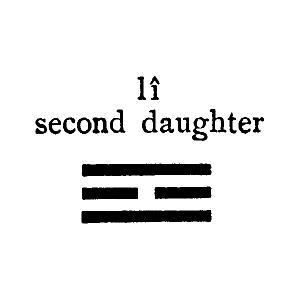
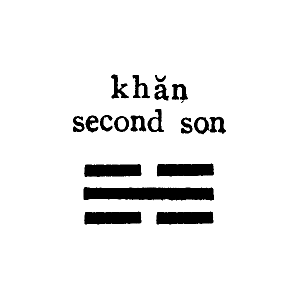
The Judgement
Before Completion is the last hexagram of the book, and it is no accident: the Book of Changes could not end with everything in order, because just as the seasons begin again, so do the phases of life. The ancient text promises progress and success, but at once shows the image of a young fox that has nearly crossed the stream when its tail gets wet: no advantage, in any way. The ship, Legge explains, has not yet reached the other side, and whoever tries to remedy disorder with impatience gets into trouble. No line is in its proper place, and yet each has its correlate: things are in disarray, but the possibilities are there. If you feel one step from the finish, a project almost done, a relationship almost cleared up, a problem almost solved, this hexagram tells you that the almost is the most delicate moment. The practical advice is not to celebrate ahead of time and to slow down precisely on the last stretch: reread, recheck, ask for confirmation. The river is crossed all the way, with the tail held high, or it is not crossed at all.
Source: James Legge, The Yî King (Sacred Books of the East, vol. XVI) (1882) · read the original passage
The Image
Water below and fire above: the two elements cannot act on each other, each goes its own way, and this is the image of disorder, of a house or a group where no one cooperates. The wise person, says the image, carefully discriminates among the qualities of things and the positions they naturally occupy. For you it means putting things in order with discernment: understanding who is suited to what, what must be done first and what after, which person goes in which role. Take your confused situation and separate the pieces: it is the first step to making them work together.
Source: James Legge, The Yî King (Sacred Books of the East, vol. XVI) (1882) · read the original passage
The six lines
First line
First line: you are like the fox whose tail gets wet. There will be cause for regret. It is the height of imprudence, says the commentary: you plunged ahead when conditions were not ready, without quite knowing where you were putting your feet. If you have already made the false step, a premature initiative, a word too many, a rash purchase, do not make things worse by insisting. Admit the mistake, pull your tail out of the water and learn to look at the river before entering it.
Source: James Legge, The Yî King (Sacred Books of the East, vol. XVI) (1882) · read the original passage
Second line
Second line: you drag back the wheel of your carriage. With firmness and correctness there will be good fortune. You have the strength to go ahead, but you know how to hold it back: it is the virtue of the central position, which makes correct even an action that on paper would not be. If you feel the urge to speed up, to force a decision, to close a negotiation or an argument quickly, brake. It is not renunciation, it is control. Whoever can keep the carriage still when needed will be ready when the moment to set out truly comes.
Source: James Legge, The Yî King (Sacred Books of the East, vol. XVI) (1882) · read the original passage
Third line
Third line: with the state of things not yet remedied, you advance anyway, and this leads to trouble. But there will be advantage in trying to cross the great stream. The text seems to contradict itself, and Legge notes that many commentators suspect a negative has dropped out. The practical sense is clear: your position is weak and wrong for an advance, and moving on your own now exposes you. If you must face the undertaking, do it with help, with a plan, with someone strong at your side. This is not the moment to launch an initiative without support.
Source: James Legge, The Yî King (Sacred Books of the East, vol. XVI) (1882) · read the original passage
Fourth line
Fourth line: by firm correctness you obtain good fortune, and every cause for regret disappears. Stir yourself, as if you were invading the Demon region, where for three years rewards will come from the great kingdom. You have the strength and solidity the time requires, and whoever is above you is humble and ready to welcome your efforts. It is the right moment to commit to long, serious work, a retraining, a recovery, a project of years: it will be hard, but the rewards will come along the way, not only at the end.
Source: James Legge, The Yî King (Sacred Books of the East, vol. XVI) (1882) · read the original passage
Fifth line
Fifth line: by firm correctness you obtain good fortune, and you have no cause for regret. In you is seen the brightness of a person of worth, and the possession of sincerity. There will be good fortune. You are in a guiding position, not particularly strong, but humble and supported by those who work with you; and your clarity spreads around and brings good. If you are leading something toward the finish, a group, a family, a venture, keep being transparent and trusting your collaborators. The light you give is what completes the crossing.
Source: James Legge, The Yî King (Sacred Books of the East, vol. XVI) (1882) · read the original passage
Sixth line
Sixth line: you are full of confidence and so you feast, quietly. There is no error. But if you cherish this confidence until you become like the fox that gets its head under water, you will fail of what is right. The work is done, and it is fair to enjoy it; the danger is to keep drinking to the success until measure is lost. Be careful: after a finish line, one toast yes, a week of excess no. Allow yourself the celebration, but keep your head out of the water, because the book always begins again.