55. Abundance
豐 · Fēng · L'Abbondanza · lines from the bottom: 101100
The two trigrams
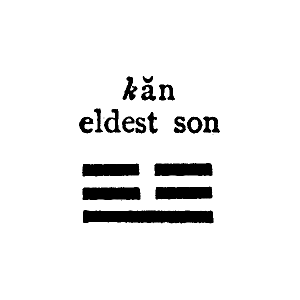
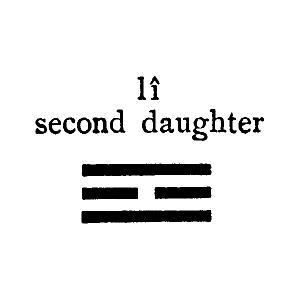
The Judgement
Abundance announces progress and development: you are in a moment of fullness, or you are getting there. The ancient text says that when a king has reached this point he has no reason to be anxious for fear of a change: he should be like the sun at noon, which lights and warms everyone. But here lies the subtlety. The sun at noon is at its peak, and after the peak the descent begins; Legge's lesson is that prosperity is preserved with intelligence and energy, not with restlessness. If you are living a happy period, a job that is going well, a full love, the accounts in order, this hexagram tells you two things: do not spoil it with the fear that it will end, and do not waste it in euphoria. The practical advice is to use the abundance to shed light around you: pay your debts, thank those who helped you, set something aside for the colder season. Whoever shines like the sun at noon and makes good use of it does not fear the evening.
Source: James Legge, The Yî King (Sacred Books of the East, vol. XVI) (1882) · read the original passage
The Image
Thunder and lightning together: the force that moves and the light that reveals. The wise person, says the image, decides cases of dispute and apportions penalties with exactness. In your life it means this is the moment to close open questions with clarity and justice: a family quarrel, an unsettled account, a misunderstanding with a colleague. The light lets you see the facts; the force lets you decide. Do not leave things to rot: call, clarify, put it in writing. But be precise and proportionate, without excess in either direction.
Source: James Legge, The Yî King (Sacred Books of the East, vol. XVI) (1882) · read the original passage
The six lines
First line
First line: you meet your companion on the road, someone with the same character and the same strength. Usually two people too alike step on each other's toes, but here there is no error: mutual help is the instrument by which abundance is maintained. Moving forward together will win approval. If you have found a partner, a colleague, an ally who resembles you, do not fear the competition: join forces. One warning only: do not try to outdo them, for that would be a misfortune.
Source: James Legge, The Yî King (Sacred Books of the East, vol. XVI) (1882) · read the original passage
Second line
Second line: you are surrounded by screens so large and thick that at midday you can see the stars of the Dipper. Whoever is above you, a boss, a parent, a manager, is in the dark and cannot see you; if you go to him trying to enlighten him, he will look on you with suspicion and dislike. Do not insist with explanations. The text advises cultivating your sincere devotion, because only sincerity touches minds: show it through deeds, with constancy, and good fortune will come.
Source: James Legge, The Yî King (Sacred Books of the East, vol. XVI) (1882) · read the original passage
Third line
Third line: the screen grows even thicker, a great banner, and in the darkness of midday you can see the small star Mei. In this darkness you break your right arm: you lose the ability to act, your main instrument. And yet there is no error, because the fault is not yours. If at work or at home the person who should cooperate with you is missing and you find your hands tied, this is not the moment to attempt great things. Protect your integrity, tend the wound, wait for the light to return.
Source: James Legge, The Yî King (Sacred Books of the East, vol. XVI) (1882) · read the original passage
Fourth line
Fourth line: you are in a tent so large and thick that at midday you can see the Dipper. Your position is not the most suitable, and around you there is darkness and no light. But you meet the person of the first line, strong like you, and there will be good fortune. It is the line of someone who, shut inside an opaque environment, finds an ally with whom to break the isolation. Look for that person: a trusted colleague, a friend who shares your values. With them action can be taken; alone it cannot.
Source: James Legge, The Yî King (Sacred Books of the East, vol. XVI) (1882) · read the original passage
Fifth line
Fifth line: whoever leads gathers around him people of brilliant ability. There will be cause for congratulation and praise, and good fortune. Alone you can do little, but if you know how to call the talents and put them to work, the results will be admirable: nothing consolidates prosperity like cooperation between those who decide and those who know how to do. If you have a position of responsibility, in a company, an association, a family, it is the right moment to delegate with trust and to surround yourself with people better than you at something.
Source: James Legge, The Yî King (Sacred Books of the East, vol. XVI) (1882) · read the original passage
Sixth line
Sixth line: you have made your house large, but it serves only as a screen for your household. You look at the door: it is still, there is no one. For three years not a soul is seen. The text speaks of misfortune. It is the image of someone who, in abundance, has shut themselves up in pride and driven everyone away; no one trusts them any more, and they are left to themselves. Be careful: if your success is isolating you, if the house is full of things and empty of people, open the door before it is too late. Invite, apologise, share.