54. The Marrying Maiden
歸妹 · Guī Mèi · La Ragazza che va sposa · lines from the bottom: 110100
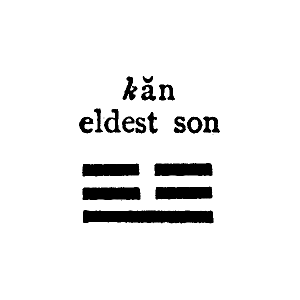
The two trigrams

The Judgement
This hexagram takes the image of a young woman given in marriage in a secondary position, and uses it to speak of every relationship entered from a disadvantaged place: a job accepted out of necessity, an agreement signed by the one with less power, a relationship in which one partner counts less than the other. The ancient text is blunt: under these conditions, acting brings trouble and gives no advantage at all. The reason, the commentators explain, is that the initiative comes from the wrong side, and that the two parties are not equals. If you feel you are in this situation, if it seems you must accept rules you did not write, this hexagram does not condemn you: it warns you. This is not the moment to force, to demand, to raise your voice to win a place that is not being granted. The practical advice is not to sign, not to promise and not to launch into anything new until conditions are fairer; meanwhile, observe carefully and keep your dignity.
Source: James Legge, The Yî King (Sacred Books of the East, vol. XVI) (1882) · read the original passage
The Image
Thunder rolls over the lake and stirs its waters: an agitation that comes from above and shakes what lies below. The wise person, says the image, looking to the far-distant end, knows the mischief that may be done at the beginning. It is a call to foresight: many troubles are born of a false step taken when everything seemed harmless. Before entering a relationship, a contract, a partnership, imagine what it will be like in five years. If you do not like the picture, the time to say so is now, not later.
Source: James Legge, The Yî King (Sacred Books of the East, vol. XVI) (1882) · read the original passage
The six lines
First line
First line: the younger sister enters the house in a secondary position, beside the real wife. It is like a person lame in one leg who still manages to walk. Going forward brings good fortune. If you find yourself in a supporting role, an assistant's post, a place that is not the one you would deserve, do not despise it: you can be truly useful, and your firmness of character will be noticed. Do well what falls to you, without complaining and without servility.
Source: James Legge, The Yî King (Sacred Books of the East, vol. XVI) (1882) · read the original passage
Second line
Second line: you are like someone blind in one eye who nonetheless sees. You have ability, but the person you should rely on, a boss, a partner, an associate, is weak and does not let you give your best. The text advises the firmness of one who stays faithful even alone, like the widow who does not remarry. In practice: keep doing your work with loyalty, even if it is not acknowledged as it should be. Devotion makes up for many disadvantages, and sooner or later it will bear fruit.
Source: James Legge, The Yî King (Sacred Books of the East, vol. XVI) (1882) · read the original passage
Third line
Third line: the young woman who was to be married finds herself in a mean position; she goes back and accepts an even more subordinate place. It is the line of someone who, out of haste or a desire to please, has put themselves in a condition that does them no honour, and ends up settling for little. Be careful: if you are accepting ever lower compromises, in love or at work, because you fear being left with nothing, stop. Better a dignified pause than an agreement that diminishes you.
Source: James Legge, The Yî King (Sacred Books of the East, vol. XVI) (1882) · read the original passage
Fourth line
Fourth line: the young woman who is to be married draws out the time. She may marry late, but the moment will come. Here the delay is a choice, not a misfortune: whoever waits does so in order not to sell themselves short. If someone is rushing you into an important decision, a commitment, a signature, a move, and you do not feel ready, you have the right to take time. The advice is to say so clearly and without guilt: good things come even late, and they come better.
Source: James Legge, The Yî King (Sacred Books of the East, vol. XVI) (1882) · read the original passage
Fifth line
Fifth line: the sister of king Ti-yi goes to her marriage with sleeves less splendid than those of the younger sister who accompanies her. It is the elegance of someone who has no need to show off: her worth is inward, like the moon almost full, luminous but not yet at its peak. The text promises good fortune. If you hold a prominent position, in the family or at work, do not try to eclipse others: measure makes you more credible. Dress in sobriety, leave room for those beside you, and you will be appreciated more than you imagine.
Source: James Legge, The Yî King (Sacred Books of the East, vol. XVI) (1882) · read the original passage
Sixth line
Sixth line: the young woman carries the basket, but it is empty; the man performs the rite, but without result. It is the image of an agreement that exists only in form: the words are there, the substance is not. The text says there is no advantage in any way. If in a relationship or a contract you feel everyone is playing their part without putting anything real into it, this is not the moment to insist. Watch out for empty promises, yours and others'. Rather than continue a pretence, clarify, or dissolve it honestly.