51. The Arousing (Shock, Thunder)
震 · Zhèn · L'Eccitante (lo Scuotimento, il Tuono) · lines from the bottom: 100100
The two trigrams
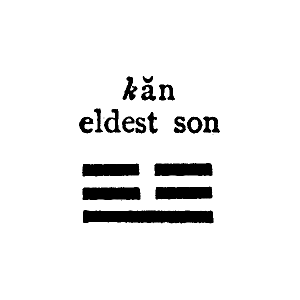
The Judgement
The thunder repeats: a jolt is coming, sudden news, a change that makes everything around you shake, at work, in the family or in the heart. And yet the hexagram speaks of ease and development. The ancient text describes the person who, when the movement comes, looks around with apprehension, but then smiles and talks cheerfully; and when the crash frightens everyone within a hundred miles, remains like someone performing a rite who does not drop the ladle or the cup of sacrificial wine. This is what it asks of you: to feel the fear, because it is healthy and keeps you awake, and at the same time not to let go of what truly matters. The practical advice is to choose your cup now, the one thing you will not drop whatever shock arrives, a commitment, a person, a responsibility, and to hold it steady while the rest trembles. Whoever crosses the thunder this way comes out of the storm stronger and more credible than before.
Source: James Legge, The Yî King (Sacred Books of the East, vol. XVI) (1882) · read the original passage
The Image
Thunder upon thunder: a crash that repeats and gives no respite. The wise person, says the image, is fearful and attentive, cultivates his virtue and examines his faults. For you it means using fear as an occasion for review, not as paralysis. If something has shaken you these days, it is no accident: it is the right moment to look inside and ask what you can correct in the way you work, love, spend. Take an hour of silence and make an honest list of what you want to improve; then begin with the first item.
Source: James Legge, The Yî King (Sacred Books of the East, vol. XVI) (1882) · read the original passage
The six lines
First line
First line: the shock approaches and you look around with apprehension; then, once the first fright has passed, you smile and speak calmly. It is the right reaction, and the text promises good fortune. If sudden news has put you on alert, let the fear do its work, which is to make you prudent, but do not let it take your smile away. Take a breath, assess calmly, and go back to talking with those close to you: shared fear weighs half as much.
Source: James Legge, The Yî King (Sacred Books of the East, vol. XVI) (1882) · read the original passage
Second line
Second line: the shock finds you in a dangerous position. The wise thing is to let go of what you hold, possessions, plans, claims, and climb to a high, safe place. Do not chase what you have lost: in seven days, that is when the cycle has closed, you will find it again. If you are about to lose something, a post, a sum, a position, do not cling: take shelter, wait for it to pass, and you will see that much of it returns on its own.
Source: James Legge, The Yî King (Sacred Books of the East, vol. XVI) (1882) · read the original passage
Third line
Third line: you are distraught amid the shocks, and you feel out of place. But the text says that if these movements drive you to act in the right way, there will be no mistake. The jolt can be the occasion to move toward a place better suited to you, a role or a situation that fits. Do not stand still trembling: use the energy of the fright to take that step you have long put off, with judgement but without hesitating.
Source: James Legge, The Yî King (Sacred Books of the East, vol. XVI) (1882) · read the original passage
Fourth line
Fourth line: amid the shocks, you sink deeper and deeper into the mud, without reacting. It is the image of someone who, pressed on every side, gives in to inertia. Be careful: the danger here is not the jolt, it is surrender. If you recognise yourself in this apathy, in a job that drags you or a relationship that dims you, the first step is small but necessary: get up, do one concrete thing today, and another tomorrow. The light in you has not yet been kindled, but it can be.
Source: James Legge, The Yî King (Sacred Books of the East, vol. XVI) (1882) · read the original passage
Fifth line
Fifth line: you go and come amid the shocks, always in peril, never a moment of quiet. And yet, says the text, perhaps you will suffer no loss and will find something to do, a task you can accomplish. Your central position protects you: you are not safe, but you are in the right place. The advice is not to look for a calm that is not there, and to focus on one concrete, achievable activity. Work done well, in the chaos, is your anchor.
Source: James Legge, The Yî King (Sacred Books of the East, vol. XVI) (1882) · read the original passage
Sixth line
Sixth line: you are breathless with fright, looking around trembling. To act now would bring trouble. But there is a way: if you take precautions while the shocks have not yet reached you and your neighbourhood, there will be no error, even if your relatives criticise you. If you see a crisis coming from afar, in the company or the family, do not wait for it to overwhelm you: put something aside, protect what you have, put your papers in order. Someone will say you exaggerate; let them say it.