52. Keeping Still (Mountain)
艮 · Gèn · L'Arresto (la Montagna) · lines from the bottom: 001001
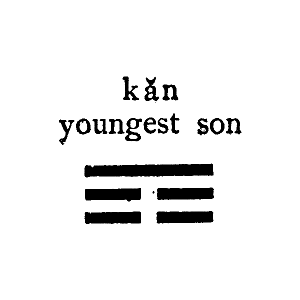
The two trigrams
The Judgement
The Mountain asks you to stop, but in a precise way. The ancient text says that when one’s rest is like that of the back, the only part of the body that desires nothing and stands straight without looking around, and one loses all consciousness of self; when one walks in the courtyard and sees none of the people in it, then there is no error. It is not an invitation to cut yourself off from the world: it is the invitation to be among people without being dragged along, staying anchored to what is right. If these days you feel pulled by a thousand demands, from work, from the family, from notifications, this hexagram tells you that your strength lies in inner quiet, not in controlling everything. The practical advice: choose a moment in the day when you really stop, without a screen and without goals, and let the mind settle. From that calm the best decisions arise, because they are dictated not by anxiety but by principle.
Source: James Legge, The Yî King (Sacred Books of the East, vol. XVI) (1882) · read the original passage
The Image
One mountain upon another: solidity resting on solidity. The wise person, says the image, does not go in his thoughts beyond the duties of the position he is in. It sounds like a limitation, and it is instead a liberation: to stop brooding over what is not yours to handle, other people's choices, a future you cannot control. For you it is the right moment to focus on what is truly in your hands today: the task on the desk, the person in front of you, this month's budget. Do that well, and the mountain will support you.
Source: James Legge, The Yî King (Sacred Books of the East, vol. XVI) (1882) · read the original passage
The six lines
First line
First line: keep your feet still, the toes that already want to move. You are at the start of something and the temptation is to set off at once; stopping now is no error, quite the opposite. The text adds, though, that it will help you to be persistently firm and correct, because your position is still fragile. Before taking the first step in a project, a relationship, an investment, ask yourself whether it is the right one, and stay faithful to that question even when impatience pushes.
Source: James Legge, The Yî King (Sacred Books of the East, vol. XVI) (1882) · read the original passage
Second line
Second line: keep your legs still, the calves. You would like to follow someone ahead of you, to help or restrain them, but they do not turn to listen, and you are left dissatisfied. It is the situation of someone who watches a colleague, a partner, a child go their own way without being able to hold them back. You cannot help those who do not want help: accept this limit without bitterness. Do your part correctly, say what you think once, and then let the responsibility rest with whoever decides.
Source: James Legge, The Yî King (Sacred Books of the East, vol. XVI) (1882) · read the original passage
Third line
Third line: keep your hips still, and so you separate the upper part of the body from the lower. It is a forced quiet, imposed with rigidity, and the text calls it dangerous: the heart glows with suppressed excitement. Be careful not to confuse calm with blockage: if you are choking down anger, a desire, a decision, sooner or later the tension explodes, perhaps in the wrong place. Find a healthy outlet, talk to someone, walk, write. True quiet is not achieved by clenching your teeth.
Source: James Legge, The Yî King (Sacred Books of the East, vol. XVI) (1882) · read the original passage
Fourth line
Fourth line: keep your trunk still, the torso. Here the quiet reaches the centre of the body and becomes genuine: there is no error. You cannot yet bring calm to others, but at least you keep yourself free from agitation, and that is not little. If you are responsible for other people, in the family or at work, start here: your balance is the first service you render. Cultivate a routine that keeps you steady, sleep, meals, movement, and do not ask more of yourself for now.
Source: James Legge, The Yî King (Sacred Books of the East, vol. XVI) (1882) · read the original passage
Fifth line
Fifth line: keep your jaws still, and so your words are all orderly. Every cause for regret disappears. It is the line of someone who has learned not to talk rashly: words spoken with measure turn out to accord with what is right. If you are about to answer a message in the heat of the moment, to say something in a meeting or in the family you would later regret, this line tells you to wait. Count to ten, rephrase, and speak only when the sentence is clear in your head.
Source: James Legge, The Yî King (Sacred Books of the East, vol. XVI) (1882) · read the original passage
Sixth line
Sixth line: devotedly maintain your quiet, all the way. It is the summit of the mountain, the full calm that is no longer effort but nature, and the text promises good fortune: to the end you show yourself generous and good. If you have come through a period of tension, know that the stability you have won now holds, and from there you can help others with serenity. It is the right moment to be the fixed point for those around you: not with sermons, but with your tranquil presence.