41. Decrease
損 · Sǔn · La Diminuzione · lines from the bottom: 110001
The two trigrams
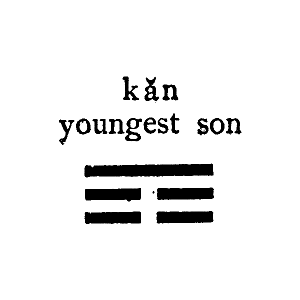
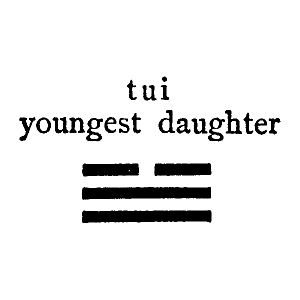
The Judgement
This is the hexagram of decrease: a time in which something is taken away, reduced, given up. It may be a cut in spending, a sacrifice for a family member, a scaling down of ambitions, a contribution asked of you. The old text says that all this, if done with sincerity, brings great good fortune: one is free from error, one can maintain firm correctness, and there is advantage in every movement undertaken. Then it asks in what this sincerity should be employed, and the answer is of a moving simplicity: even in the most solemn sacrifice two baskets of grain are enough, if one has nothing else. It means that what counts is not the quantity of what you give or what you give up, but the intention with which you do it. If in this period you have to tighten your belt, or give up something you like for a greater good, do not be ashamed if your contribution is small. The practical advice: identify an excess, of spending, of words, of demands, and reduce it decisively; and when you give, give with your heart, without keeping count.
Source: James Legge, The Yî King (Sacred Books of the East, vol. XVI) (1882) · read the original passage
The Image
The image is a mountain with a lake beneath it: the water of the lake rises as vapour to bedew the mountain, and what is taken from below makes the green grow above. The wise person, in accordance with this, restrains their anger and represses their desires. Decrease, here, is work on oneself: removing the excess of rage and the excess of cravings that make us less free. In practice, when you feel anger rising over a crooked word, or the urgent need to buy, to answer back, to have more, stop and take something away. The advice: choose one reaction that harms you and reduce it by a degree every day; that is how the mountain is covered in green.
Source: James Legge, The Yî King (Sacred Books of the East, vol. XVI) (1882) · read the original passage
The six lines
First line
You suspend your own affairs and hurry to help someone who needs you: you commit no error. You are strong, and the one calling you is in difficulty. But the text adds a wise recommendation: consider carefully how far to contribute of what is yours. Helping does not mean emptying yourself. If a friend, a family member or a colleague asks you for time, money or energy, give willingly, but with measure, without leaving your own responsibilities half done.
Source: James Legge, The Yî King (Sacred Books of the East, vol. XVI) (1882) · read the original passage
Second line
Here it is advantageous to maintain firm correctness, and acting would be harmful. You are in a central and solid position: the best way to help the one above you, a boss, a partner, a parent, is not to run to them but to stay in your place and do your own work well. You can give increase to others without taking anything from yourself, simply through your example. If you feel guilty for not intervening, remember that stability is already a gift. Do not move: hold your position.
Source: James Legge, The Yî King (Sacred Books of the East, vol. XVI) (1882) · read the original passage
Third line
When three people walk together, the number is diminished by one; when one walks alone, they find their friend. It is a simple law of life: among three, suspicion and jealousy arise; between two, a true bond is built. If in a relationship, a project or a friendship there is an awkward third party, or if you yourself are the third, the text suggests accepting the decrease. The advice: seek the relationship of two, clear and direct, and let the triangulations go.
Source: James Legge, The Yî King (Sacred Books of the East, vol. XVI) (1882) · read the original passage
Fourth line
You diminish the ailment you suffer from by making the one who can help you hasten to your side, and they are glad of it. You are in a weak position, like someone ill who cannot do their own work; but there is someone with the strength and the will to lend you a hand, and your joy in receiving it is part of the healing. There will be no error. If you feel down, do not be proud: call the person you know would come. Letting yourself be helped is already diminishing the problem.
Source: James Legge, The Yî King (Sacred Books of the East, vol. XVI) (1882) · read the original passage
Fifth line
Someone adds ten pairs of tortoise shells to your stores, a gift of enormous value, and accepts no refusal: great good fortune. You are in a position of responsibility but with humility, and precisely for this reason everyone of worth wants to lend you a hand. It is the blessing that comes from above, what you cannot procure for yourself and that arrives because you deserve it. If you are offered help, an opportunity, a recognition, do not be so modest as to refuse. Accept with gratitude: it is yours.
Source: James Legge, The Yî King (Sacred Books of the East, vol. XVI) (1882) · read the original passage
Sixth line
You give increase to others without taking anything from yourself: there is no error, with firm correctness there will be good fortune, and advantage in every movement. You will find helpers more than can be counted by their clans. It is the line of one who has received much and now gives back, who generates value instead of hoarding it. If you have reached a point of abundance, in experience, in means, in affection, this is the moment to share without fear of becoming poorer: the more you give, the more people gather around you.