40. Deliverance
解 · Xiè · La Liberazione · lines from the bottom: 010100
The two trigrams
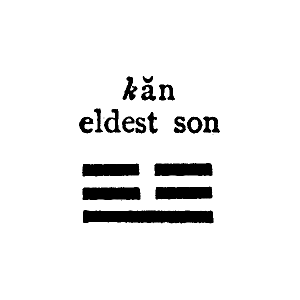
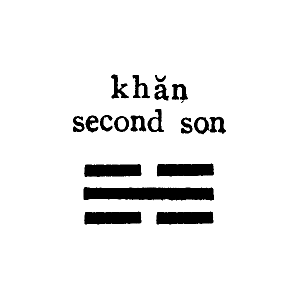
The Judgement
The name of this hexagram means loosening: untying a knot, unravelling a tangle. It is the moment when the obstacle that blocked you is removed and you can breathe again. If you have just come through a crisis, an illness, a quarrel, a period of tight money, the old text tells you how to manage this new phase. Here too advantage is found in the south-west, that is on easy ground, in the habits and relationships you know. And then it places a simple fork in front of you. If there is nothing more to be done, if the difficulty has truly passed, good fortune lies in coming back to the old conditions: resuming normal life as soon as possible, without wanting to change everything by force. If instead something remains to be settled, good fortune lies in doing it right away, without delay. The practical advice is not to stay suspended: assess honestly whether the matter is closed, and then relax and return to your own things; or, if there is still a piece to close, a phone call, a payment, a clarification, do it within this week. Deliverance is consolidated by promptness.
Source: James Legge, The Yî King (Sacred Books of the East, vol. XVI) (1882) · read the original passage
The Image
The image is thunder and rain manifesting together: the storm breaks, the air clears and the feeling of oppression goes away. It is spring after the frost. The wise person, in accordance with this, forgives errors and deals gently with offences. When a tension has dissolved, the way to keep it from returning is not to press the advantage: do not keep bringing it up, do not keep score, do not demand that whoever erred pay to the last penny. In practice, if someone has wronged you and now the worst has passed, allow yourself to let go. The advice: distinguish between those who erred out of weakness and those who erred out of malice, and be generous with the former.
Source: James Legge, The Yî King (Sacred Books of the East, vol. XVI) (1882) · read the original passage
The six lines
First line
The line is very short: you will commit no error. You are at the beginning of the deliverance, in a low position and with little strength, but above you there is someone solid who corresponds to you and supports you. There is no need to do anything special: the danger has passed and the best thing is to stay calm and enjoy the relief. If you feel obliged to prove something right after a crisis, let it go: rest, and take up your habits again one at a time.
Source: James Legge, The Yî King (Sacred Books of the East, vol. XVI) (1882) · read the original passage
Second line
Hunting, you catch three foxes and obtain the yellow, that is golden, arrows. The foxes are the cunning and unreliable people who took advantage of the confusion; the straight arrows of the right colour are your honesty joined with moderation. You are like a good collaborator cleaning up the environment after the storm. With firm correctness there will be good fortune. The advice: remove those who played dirty, but do it with balance, without using brute force, otherwise you only provoke resentment.
Source: James Legge, The Yî King (Sacred Books of the East, vol. XVI) (1882) · read the original passage
Third line
A porter with his burden riding in a carriage: a person occupying a place that does not belong to them, with means that are not theirs. People will wonder how they got there, and robbers will be tempted to attack. However much you try to be correct, there will be cause for regret. If you have found yourself in a position above your abilities or obtained in a questionable way, admit it before others do. The advice: return to the measure that belongs to you, or work hard to deserve the one you occupy.
Source: James Legge, The Yî King (Sacred Books of the East, vol. XVI) (1882) · read the original passage
Fourth line
To this line it is said: remove your toes, that is free yourself from what keeps you attached below, the tie to unsuitable people or to habits that pull you down. Only then will the friends come, those with whom there will be mutual confidence. If in this period you have around you people who stay close only out of convenience, or company that keeps you from growing, the text invites you to cut, kindly but firmly. Make room, and the right people will fill it.
Source: James Legge, The Yî King (Sacred Books of the East, vol. XVI) (1882) · read the original passage
Fifth line
The superior person, the one with responsibility, carries out their duty of removing what is harmful, and then there will be good fortune and even the small people will show confidence in them. You are in the position of one who leads, at home, in the office, in a group, and you must clear away what obstructs: a wrong practice, a toxic relationship, a useless expense. Do it with sincerity and determination: those who see you mean it will adjust on their own. The advice: announce clearly what changes, and then keep to it.
Source: James Legge, The Yî King (Sacred Books of the East, vol. XVI) (1882) · read the original passage
Sixth line
A prince shoots with his bow at a falcon on top of a high wall, and hits it: it will be advantageous in every way. The falcon is the last element of disorder, the troublemaker who has perched high up and from there keeps doing damage. You have the position and the means to strike with precision, without spreading conflict around. If there is a person or a problem that remains the only obstacle to your peace of mind, do not wait for it to come down on its own. Take aim calmly and settle the matter once and for all.