39. Obstruction
蹇 · Jiǎn · L'Impedimento · lines from the bottom: 001010
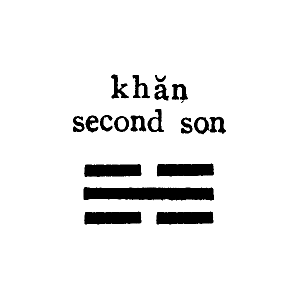
The two trigrams

The Judgement
The name of this hexagram points to a leg that will not hold, difficulty in walking: it is a time in which every step costs effort and obstacles seem to multiply. If you feel this way, the old text gives you three concrete indications. The first concerns direction: advantage lies in the south-west, that is in the plain, on easy ground, in situations you know and can cross; disadvantage lies in the north-east, the mountain, the rough ground, the challenges you do not have the strength to face today. Choose your battles according to circumstances, not pride. The second indication: it will be advantageous to meet the great man, someone with experience and authority, a mentor, a professional, a wise friend, who helps you see the road. The third: even with the right direction and the right help, firmness and correctness are needed, and then there will be good fortune. The practical advice: make a list of what you can solve now and what must be postponed, ask advice from those who know more than you, and do not take shortcuts to get there faster.
Source: James Legge, The Yî King (Sacred Books of the East, vol. XVI) (1882) · read the original passage
The Image
The image is a mountain with water above it: two signs of danger, one below and one above, a steep climb and, at the top, a stream to ford. Faced with so many obstacles, the wise person does something that seems strange: they turn round toward themselves, examine themselves, and cultivate their virtue. When what we do does not obtain what we want, the ancients said, we must look inward and seek in ourselves the point to correct. In practice, if a project does not take off or a relationship gets stuck, before blaming the world ask yourself what you can improve. The advice: use the period of blockage to work on yourself, not to accuse others.
Source: James Legge, The Yî King (Sacred Books of the East, vol. XVI) (1882) · read the original passage
The six lines
First line
If you advance now, you will meet greater difficulties; if you stay put, you will even earn the esteem of others. You are at the beginning, with little strength, and facing the obstacles head-on would mean being overwhelmed by them. It is not cowardice to wait: it is judgement. If you are about to throw yourself into an argument, an investment, a request, postpone it. The advice is to wait for a more favourable moment, and in the meantime observe and prepare.
Source: James Legge, The Yî King (Sacred Books of the East, vol. XVI) (1882) · read the original passage
Second line
This line describes the king's minister struggling with one difficulty after another, and not for his own advantage: he does it out of duty, for the person or the cause he is bound to. If you recognise yourself in someone who works hard for the family, for the company, for someone who counts on you, know that the value of what you do does not depend on immediate success. In the end no blame will be attached to you. Keep doing your part with loyalty, without expecting applause.
Source: James Legge, The Yî King (Sacred Books of the East, vol. XVI) (1882) · read the original passage
Third line
You advance, but only toward greater difficulties: so you stop and return to your own, to the people close to you who count on you. You are strong, but whoever should support you on the other side is weak, and going on alone would make no sense. The text says that those beside you rejoice at your return. If you have neglected family or old friends to chase a goal that keeps receding, this is the moment to go home and recharge there.
Source: James Legge, The Yî King (Sacred Books of the East, vol. XVI) (1882) · read the original passage
Fourth line
Here too advancing would bring only greater difficulties: you stay put and unite with the one above you, the solid and well-placed person to whom you can bind yourself with loyalty. Alone you could do little; at the side of someone stronger you can wait for the moment when acting will be useful. If you have a boss or partner you respect, stay close to them in this period, cultivate mutual trust, and do not try to do everything on your own.
Source: James Legge, The Yî King (Sacred Books of the East, vol. XVI) (1882) · read the original passage
Fifth line
You are struggling with the greatest difficulties, but friends are coming to help you. You are in the position of someone who has the strength and the responsibility, and precisely for this reason the load is heavy; but you are also at the centre, with the right qualities, and you attract the support of those below and around you. If you feel alone with an enormous problem, look around: help is closer than you think. The advice: ask, accept, and do not play the strong one at all costs.
Source: James Legge, The Yî King (Sacred Books of the East, vol. XVI) (1882) · read the original passage
Sixth line
Going forward would only increase the difficulties, while staying put will produce great merit: there will be good fortune, and it will be advantageous to meet the great man. The action of the hexagram is over: there is nothing more to conquer ahead. Your task now is to support the one immediately below you, the capable person who carries the weight of the situation. If you have reached the end of a road, do not look for yet another challenge: put your experience at the service of the one who leads, and that will be your greatness.