38. Opposition
睽 · Kuí · L'Opposizione · lines from the bottom: 110101
The two trigrams
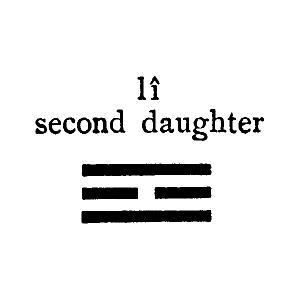

The Judgement
This hexagram describes a time of division: people drifting apart, groups not speaking to each other, a couple in which each pulls their own way, an office split into factions. If these days you feel surrounded by misunderstandings, know that the old text does not promise a miracle, but it does not close the door either: it says that, in spite of everything, in small matters there will still be good success. It is a modest promise and for that reason a credible one. You cannot mend everything in one stroke, but you can succeed in small things, and it is precisely from there that the healing of the whole is prepared. The practical advice: do not seek the great reconciliation, seek the small one. A coffee with the person you argued with, a message without polemic, a task solved together, a favour asked and returned. Every small success rebuilds a piece of trust, and trust, accumulated, is what will one day allow the big questions to be faced as well. Today, however, keep your ambitions low and your kindness high.
Source: James Legge, The Yî King (Sacred Books of the East, vol. XVI) (1882) · read the original passage
The Image
The image is fire above and the water of a marsh below: fire rises, water sinks, they move in opposite directions while staying in the same picture. The wise person draws a precious lesson from this: even where there is general agreement, they admit diversity. It means you can be a team, a couple, a family, without demanding that everyone think the same way. In practice, when in a discussion you feel the need for the other person to agree with you on everything, stop: look for the common goal and leave the differences of style, taste and opinion free. The advice: agree on the destination, and allow yourselves different roads to get there.
Source: James Legge, The Yî King (Sacred Books of the East, vol. XVI) (1882) · read the original passage
The six lines
First line
Every cause for regret disappears. You have lost your horses, that is a support, an opportunity, an ally: do not run after them, they will come back on their own. In a time of division, those who share similar values end up finding each other again. And if you meet people of little repute, you will not err in speaking with them: a civil exchange can defuse their gossip. The advice: do not chase those who have drifted away and do not avoid those hostile to you; stay in your place with courtesy.
Source: James Legge, The Yî King (Sacred Books of the East, vol. XVI) (1882) · read the original passage
Second line
You happen to meet your lord in a bye-passage: not in an official meeting, but in the corridor, in the lift, at a dinner. In a period of division, an informal encounter with the person who matters, a boss, a partner, a parent, is worth more than a thousand formal appointments that cannot be arranged. There will be no error: you have not deviated from the right path to obtain it. The advice is to seize the casual chances for dialogue, without forcing them and without wasting them.
Source: James Legge, The Yî King (Sacred Books of the East, vol. XVI) (1882) · read the original passage
Third line
Your carriage is dragged back, the oxen pushed back, and you yourself suffer a public humiliation: you are caught between two forces larger than you, and in a time of division you end up being checked and mortified. But the text is clear: there is no good beginning, but there will be a good end. Those who obstruct you today will prove, in the long run, to be a support. If you feel blocked and wounded in your pride, do not answer in the same tone: hold on, do your part, and let time set things right.
Source: James Legge, The Yî King (Sacred Books of the East, vol. XVI) (1882) · read the original passage
Fourth line
You are alone amid the general disunion: no one who truly corresponds to you, no natural ally. But you meet the good person, the one you can trust, and your sincere desires blend together. The position remains risky, but there will be no mistake. If you feel isolated at work or in the family, look for the single honest person with whom to share a goal, even if they are not the most powerful. Two sincere people, in a time of division, achieve more than a crowd.
Source: James Legge, The Yî King (Sacred Books of the East, vol. XVI) (1882) · read the original passage
Fifth line
Every cause for regret disappears: you unite with your relative, the trusted person who serves as your right hand, as easily as biting through a piece of soft skin. With such help, going forward cannot be an error. This line tells you to lean without fear on those close to you by bond and by loyalty: a sibling, a long-standing partner, a faithful collaborator. The advice: delegate, share the decision, and move together with those who are truly loyal to you.
Source: James Legge, The Yî King (Sacred Books of the East, vol. XVI) (1882) · read the original passage
Sixth line
You are alone amid the disunion and see everything with the eye of suspicion: the person coming toward you looks like a pig covered in mud, or a carriage full of ghosts. You bend your bow against them, and then lower it, because you discover they are not an enemy but a near relative, someone who cares about you. Going forward you will meet the genial rain, and there will be good fortune. If these days you distrust everyone, ask yourself whether you are projecting fears onto those close to you. Lower the bow, and the doubts will dissolve.