37. The Family
家人 · Jiā Rén · La Famiglia · lines from the bottom: 101011
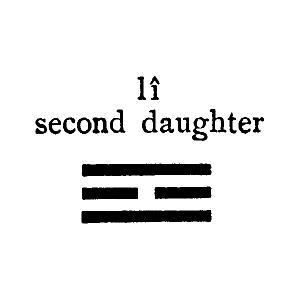
The two trigrams

The Judgement
This hexagram speaks of the home, the family, the people with whom you share a roof and everyday life. The old text says that, for a family to work well, the most advantageous thing is that the wife be firm and correct: in the language of that time, the person holding the centre of the home must have solid principles and keep them steadily. Translated into today's terms: a home stands if whoever holds its heart, whoever that may be, does not give in to the small daily incorrectnesses, keeps their word, does their part with dignity. If in this period you feel tension within the walls of your home, arguments about money, chores, children, the answer is not a grand gesture but quiet firmness in everyday things. The practical advice: put in writing who does what, respect it, and let the one whose role is to hold the others together be the first to set the example. From an orderly family, says the text, comes the order of everything else.
Source: James Legge, The Yî King (Sacred Books of the East, vol. XVI) (1882) · read the original passage
The Image
The image is fire from which wind comes forth: as heat generates a current of air that spreads, so good influence is born inside the home and reaches outward. The wise person, faced with this, orders their words according to the truth of things and their conduct so that it is always consistent. In practice: at home do not promise what you will not keep, do not say one thing today and the opposite tomorrow, do not ask of your children or partner what you yourself do not do. Credibility at home is built on consistency between words and deeds, day after day. The advice: if you have made a mistake, say so simply and correct it; it is consistency that keeps the hearth warm.
Source: James Legge, The Yî King (Sacred Books of the East, vol. XVI) (1882) · read the original passage
The six lines
First line
Establish clear rules at home from the very beginning: schedules, chores, limits. The text says that in this way every cause for regret disappears, because rules set early, before habits go bad, prevent the conflicts of later on. If you are starting to live together, getting married, or welcoming someone into your home, do not postpone the practical conversations for fear of seeming strict. Talk about them right away, calmly, and reach an agreement.
Source: James Legge, The Yî King (Sacred Books of the East, vol. XVI) (1882) · read the original passage
Second line
This line describes someone who, in the central position of the home, claims nothing for themselves and attends to preparing the food, that is to making the concrete things of every day work. It is a modest role only in appearance: it is what keeps a family alive. If you are the one carrying the daily routine, know that your firm correctness brings good fortune to everyone. If instead someone else does it, acknowledge it and say thank you, this very day.
Source: James Legge, The Yî King (Sacred Books of the East, vol. XVI) (1882) · read the original passage
Third line
You treat your family members with severity: there will be moments of regret and some risk, but also good fortune, because firmness is better than indulgence. The text adds that if only giggling and chatter reigned at home, with no composure at all, in the end there would be cause for regret. The meaning is that a home with no rules at all falls apart. If you feel guilty for having said a firm no to a child or a partner, do not torment yourself: adjust the tone, but do not withdraw the no.
Source: James Legge, The Yî King (Sacred Books of the East, vol. XVI) (1882) · read the original passage
Fourth line
You enrich the family, and the text promises great good fortune. The wealth of a home does not lie only in money, though sound management of the budget is part of it: it lies in the affection and harmony among those who live there. Where these exist, one is rarely poor, and what one has is well preserved. If in this period you can do something for the peace of your home, an investment, a repair, a gesture of care, do it: it pays more than any other expense.
Source: James Legge, The Yî King (Sacred Books of the East, vol. XVI) (1882) · read the original passage
Fifth line
The influence of the king extends to his family: whoever has authority, at home or outside, exercises it first among their own, and does so with mutual love, not with commands. There is no reason for anxiety, there will be good fortune. If you have responsibility for other people, remember that your first testing ground is your home: how you speak to your partner, how you listen to your children, how you treat the most fragile. The advice: this week, devote real time, without your phone, to the people of your household.
Source: James Legge, The Yî King (Sacred Books of the East, vol. XVI) (1882) · read the original passage
Sixth line
You are a sincere person and, at the same time, you have a dignity that shows, an authority you do not need to impose. The text says that in the end there will be good fortune. The majesty it speaks of is not a pose: it is the result of a character shaped over the years. If someone in the family has stopped listening to you, do not raise your voice: go back to being consistent with what you ask. An adult who walks the right path makes those beside them walk it too.