34. The Power of the Great
大壯 · Dà Zhuàng · La Potenza del Grande · lines from the bottom: 111100
The two trigrams
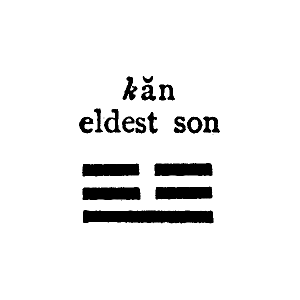
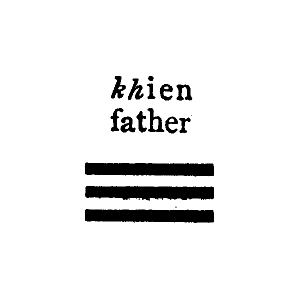
The Judgement
You are in a moment of great strength: the energy is there, your health holds, your ideas are clear and you want to act. It is no accident that you feel ready to push a project, to ask for that raise, to finally say what you think. But the old text adds one condition, and it is the one that counts: strength brings advantage only if it stays firm and correct. In other words, power alone is not enough to run things well; it must be placed at the service of what is right and used only in harmony with it. So be careful not to confuse strength with bullying, enthusiasm with haste, confidence with arrogance. The practical advice: before every important move, ask yourself whether you would do it even if no one were watching and if you were on the other side. If the answer is yes, go ahead with all your energy; if it is no, that same energy will turn against you.
Source: James Legge, The Yî King (Sacred Books of the East, vol. XVI) (1882) · read the original passage
The Image
The image is thunder rolling above the sky and making everything shake: it is the sign of great power. And what does the wise person do in the face of so much strength? They do not take a single step that is not according to propriety. The ancients said that the truly strong person is the one who overcomes themselves, and this is exactly the point here: the more energy you have, the more you must keep it within good manners, respect for the rules and for people. In practice, when you feel strong, measure your words, keep your schedules and commitments, do not use your position to crush those with less of a voice. The advice is to make strength and good measure coincide: that way no one will be able to reproach you for anything.
Source: James Legge, The Yî King (Sacred Books of the East, vol. XVI) (1882) · read the original passage
The six lines
First line
Strength reaches all the way to your toes: you are charged up and want to set off right away. But you are still at the beginning, in the lowest position, with no secure support and no one answering you from the other side. Advancing now would lead to trouble, and the text says so in no uncertain terms. The advice is to hold back the impulse: prepare the ground, look for allies, and keep the push for when it will have something to rest on.
Source: James Legge, The Yî King (Sacred Books of the East, vol. XVI) (1882) · read the original passage
Second line
Here strength is tempered by position: you are at the centre, balanced, and your energy does not make you lose your head. It is the simplest and most reassuring line of the hexagram: with firmness and correctness there will be good fortune. In practice it means you can carry your project, your negotiation, your clarification forward, provided you do not cheat and do not overdo it. Move ahead at a steady pace, without sudden bursts.
Source: James Legge, The Yî King (Sacred Books of the East, vol. XVI) (1882) · read the original passage
Third line
Faced with an obstacle, the small person uses all their strength; the wise person makes it a rule not to. You are at the edge of the safe zone and, even with the best intentions, the position is risky: whoever charges head down does like the ram butting against the fence and getting its horns stuck. If you feel provoked, do not answer with brute force. Stop, weigh things up and look for another way.
Source: James Legge, The Yî King (Sacred Books of the East, vol. XVI) (1882) · read the original passage
Fourth line
Here correct firmness brings good fortune and every cause for regret disappears: the fence opens and the horns do not get caught. Your strength is like that of the spokes in the wheel of a large wagon, solid, well distributed, able to bear real weight. In life this means that, if you proceed with care, the obstacles you feared clear away on their own. The advice is to keep going like this: a decisive step, but no collisions.
Source: James Legge, The Yî King (Sacred Books of the East, vol. XVI) (1882) · read the original passage
Fifth line
You lose your ram-like strength in the ease of the position you are in: you have reached a certain comfort, things are going well, and the aggressive push of before dissolves. This is not bad, and indeed there will be nothing to regret. The message is that not everything has to be won by force: sometimes it is enough to be well where you are. The advice is to let go of the urge to prove yourself, and to enjoy the peace you have reached without guilt.
Source: James Legge, The Yî King (Sacred Books of the East, vol. XVI) (1882) · read the original passage
Sixth line
You are like the ram that has butted the fence and now can neither go back nor go forward as it would like. If you feel stuck in a situation you yourself forced, a stubborn stand, one word too many, a choice made out of pride, know that for now there is no advantage in any direction. But the text leaves a door open: if you realise the difficulty, if you admit you have got yourself wedged in, good fortune will come. Acknowledge it, even out loud, and the error will not last.