14. Possession in Great Measure
大有 · dà yǒu · Il Possesso Grande · lines from the bottom: 111101
The two trigrams
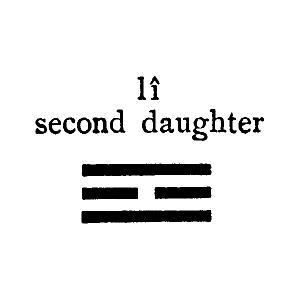

The Judgement
The name of this hexagram means great havings: abundance, prosperity, wealth, in a state as in a family or an individual. And the Judgment, very brief, says everything that is needed: under the circumstances it implies, there will be great progress and success. If you are in a season of harvest right now, a good salary, a home that finally works, a job that pays, health regained, an affection that fills you, that is no accident: you hold a great possession in your hands. But the commentators point out where the good fortune of this hexagram comes from. The place of honour, the fifth line, is occupied by a weak line, that is, by a humble and sincere person, and all the strong lines around obey it in sympathy. Wealth threatens its owner with pride, and it is precisely the humility of the one at the centre that keeps that danger away. Great possession, in short, lasts only if the one who has it stays modest, generous, able to listen. Practical advice: in this time of plenty, do not raise your voice or your lifestyle in a showy way; share in moderation, thank those who helped you, and keep your accounts in order.
Source: James Legge, The Yî King (Sacred Books of the East, vol. XVI) (1882) · read the original passage
The Image
The Image is heaven with fire above it: a fire that high shines far and lights up a vast territory, and it is the symbol of the greatness of what one possesses. The wise person, Legge says, in accordance with this, represses what is evil and gives distinction to what is good, in sympathy with the excellent Heaven-conferred nature. In a time of prosperity, the responsibility is to make the good grow, in people and in oneself, and to keep the bad in check. If you have resources, use them to reward those who deserve it and not to feed envy and waste. Advice: choose each day one good thing to support and one bad thing you will no longer tolerate.
Source: James Legge, The Yî King (Sacred Books of the East, vol. XVI) (1882) · read the original passage
The six lines
First line
First line: there is no approach to what is injurious, and there is no error. Let there be a realisation of the difficulty and danger of the position, and there will be no error to the end. You are at the start of prosperity, low down, without ties that compromise you: no harmful influence has touched you yet. The secret of staying clean is to remember that wealth brings risks: easy debt, self-interested friends, arrogance. If you are beginning to earn well, keep this vigilance. Advice: set spending rules right away and do not be dazzled by the first income.
Source: James Legge, The Yî King (Sacred Books of the East, vol. XVI) (1882) · read the original passage
Second line
Second line: a large waggon with its load. In whatever direction advance is made, there will be no error. You have accumulated resources, skills, credibility: the commentary speaks of accumulated virtue, such that you will suffer no loss in the conduct of affairs. The waggon holds, and you can load it and go. If you are weighing a project, an investment, a move, your shoulders are broad enough to carry it. Just remember that your strength serves the one at the centre, humbly. Advice: by all means move, but with a written plan and with whoever guides you kept informed.
Source: James Legge, The Yî King (Sacred Books of the East, vol. XVI) (1882) · read the original passage
Third line
Third line: a feudal prince presenting his offerings to the Son of Heaven. A small man would be unequal to such a duty. You are in a prominent position, head of your own territory, and what you have you place at the disposal of the one above you, loyally, instead of keeping it for yourself. Whoever has the place without the virtue, the commentary says, gives himself airs and does himself harm. If you have reached an important role, remember that your possession is also a service. Advice: offer part of what you have, time, money, skills, to the common cause.
Source: James Legge, The Yî King (Sacred Books of the East, vol. XVI) (1882) · read the original passage
Fourth line
Fourth line: you keep your great resources under restraint. There will be no error. You are very close to the one in command, and you have strength and means; but your position asks you not to use them to cast a shadow. The commentary says your wisdom discriminates clearly what you ought to do. If you are somebody's right hand, the partner with more capital, the most capable child, do not make your superiority felt. Advice: step back on public occasions and let your work do the talking.
Source: James Legge, The Yî King (Sacred Books of the East, vol. XVI) (1882) · read the original passage
Fifth line
Fifth line: your sincerity is reciprocated by that of all the others. But let him display a proper majesty, and there will be good fortune. You are at the centre, mild and sincere, and precisely for that reason everyone comes towards you. But the commentary warns: without a measure of dignity, the others might feel too easy and stop making an effort. If you lead with kindness, a family, a group, a company, do not give up being respected. Advice: stay warm, but keep one firm point that is not up for discussion.
Source: James Legge, The Yî King (Sacred Books of the East, vol. XVI) (1882) · read the original passage
Sixth line
Sixth line: you have help accorded to you from Heaven. There will be good fortune, advantage in every respect. It is the topmost line, and instead of ending in excess, as so often happens at the top, here it meets approval: your strength stays tempered by the humility of the one at the centre, and that is why everything works out for you. If right now you feel everything is going the right way, almost without effort, receive it with gratitude and not with pride. Advice: thank openly those who supported you, and use your good fortune to do good around you.