15. Modesty
謙 · qiān · La Modestia · lines from the bottom: 001000
The two trigrams
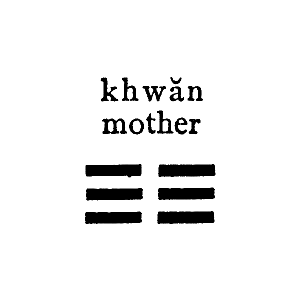
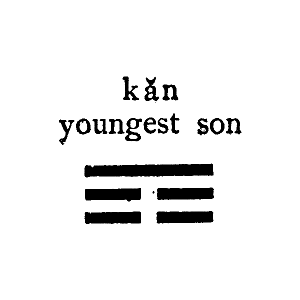
The Judgement
After great possessions comes, rightly, modesty: and this is one of the few hexagrams in which every line is favourable. The Judgment says that modesty indicates progress and success, and that the superior man, being humble as the hexagram implies, will bring his undertakings to a good issue. This is not praise of shyness or of holding back: the modesty spoken of here is that of someone with real strength, the one whole line at the centre of the hexagram, who chooses not to flaunt it, but to keep it in the service of others. If these days you have achieved something, a promotion, an award, a result that got you noticed, or if on the contrary you feel your worth goes unseen, this hexagram tells you the same thing: the road to lasting success runs through not letting it go to your head and not making demands. It is humility that makes a person loved and followed, with no need for titles or riches. At work, the one who does not boast is sought out; in love, the one who does not demand is chosen; in the family, the one who does not raise his voice is listened to. Practical advice: the next time you would like to point out a merit of yours, let the facts speak, and spend that energy recognising someone else's merit.
Source: James Legge, The Yî King (Sacred Books of the East, vol. XVI) (1882) · read the original passage
The Image
The Image is the earth with a mountain in the midst of it: something high that agrees to stand within what is low. The wise person, Legge says, in accordance with this, diminishes what is excessive in himself and increases where there is any defect, bringing about an equality, according to the nature of the case, in his treatment of himself and others. It is a work of levelling: taking away where there is too much, pride, demands, spending, words, and adding where there is too little, listening, care, rest. It applies to judging others too: do not weigh the same mistake twice. Advice: make a list of what you have in excess and what you lack, and restore the balance.
Source: James Legge, The Yî King (Sacred Books of the East, vol. XVI) (1882) · read the original passage
The six lines
First line
First line: the superior man who adds humility to humility. Even the great stream may be crossed with this, and there will be good fortune. You are at the beginning, low down, and your humility is twofold: you have no position, and you claim none. The commentary says that in this way you nourish your virtue in lowliness. If you are about to face something big, an exam, a new job, a personal trial, present yourself without arrogance and without fear. Advice: ask for advice, listen, and cross the stream with the step of someone who has nothing to prove.
Source: James Legge, The Yî King (Sacred Books of the East, vol. XVI) (1882) · read the original passage
Second line
Second line: humility that has made itself recognised. With firm correctness there will be good fortune. Your modesty is not a pose: it comes from the core of your heart, the commentary says, and precisely for that reason others notice it, without your having to proclaim it. If the people around you have begun to trust you, to hand you tasks, to ask your opinion, it is because they have seen that you do not seek glory. Advice: carry on like this, with constancy, and do not turn your modesty into a boast.
Source: James Legge, The Yî King (Sacred Books of the East, vol. XVI) (1882) · read the original passage
Third line
Third line: the superior man of acknowledged merit, and yet humble. He will maintain his success to the end and have good fortune. This is the lord of the hexagram: the only strong line, to which all the others turn. You have done a great deal, everyone knows it, and even so you set yourself above no one. The commentary says the myriads of the people will submit to you. If you have become a point of reference, at work, among friends, in the family, your modesty is what makes your success last. Advice: finish what you have started without looking for applause.
Source: James Legge, The Yî King (Sacred Books of the East, vol. XVI) (1882) · read the original passage
Fourth line
Fourth line: one whose action would be in every way advantageous, who stirs up his humility the more. You are in a good position, near the one in command, and everything would succeed for you; and yet, right there, you choose to be even more modest. The commentary says that in doing so you do not act contrary to the proper rule for your position. If you have a boss, a partner, a parent with whom relations are delicate, modesty is your protection. Advice: take no initiatives that would overshadow the one above you; work well and quietly.
Source: James Legge, The Yî King (Sacred Books of the East, vol. XVI) (1882) · read the original passage
Fifth line
Fifth line: one who, without being rich, is able to employ his neighbours. He may advantageously use the force of arms, and all his movements will be advantageous. You have neither great means nor great power, but people follow you because humility in itself is what everyone loves and honours. And modesty does not stop you from asserting what is right, firmly too, towards those who refuse to respect the rules. If someone is taking advantage of your mildness, you have the right to respond. Advice: rally those who respect you and deal decisively with whoever will not submit to what is correct.
Source: James Legge, The Yî King (Sacred Books of the East, vol. XVI) (1882) · read the original passage
Sixth line
Sixth line: humility that has made itself recognised. Whoever has it will with advantage put his hosts in motion, but only to punish his own towns and state. You are at the end of the road, your modesty is known to everyone, but the commentary says that not all your aims have been attained. You may use force, but only within your own sphere: setting order in your own house, your own work, your own habits, not going out to correct others. Advice: if you need to clean up, begin and end with what is yours.