13. Fellowship with Men
同人 · tóng rén · La Compagnia fra Uomini · lines from the bottom: 101111
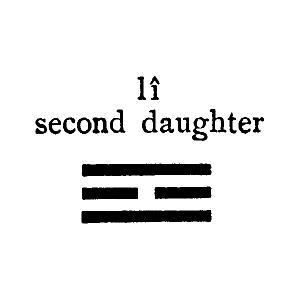
The two trigrams

The Judgement
After standstill comes fellowship among people, and the Judgment places it in a precise setting: in the open country, the remote districts, far from the power games of the cities. That detail matters: fellowship promises progress and success only if it rests on clean motives, with no private gain, as among simple folk who help each other because that is the right thing to do. If these days you are looking for allies, a group, a team, a community, or if you feel the need to break out of isolation, this hexagram encourages you: the right people are there. The Judgment adds that it will be advantageous to cross the great stream, that is, a fellowship like this can face even the hardest undertakings, a move, a change of job, a shared battle. And it closes with a condition: it will be advantageous to maintain the firm correctness of the superior man. The fellowship must not turn into a closed club or a clique of interests; it must stay open, transparent, loyal. Practical advice: join those who share your values and not merely your advantages, state clearly from the start what you want and what you offer, and enter no alliance that asks you to keep quiet about what you think.
Source: James Legge, The Yî King (Sacred Books of the East, vol. XVI) (1882) · read the original passage
The Image
The Image is heaven and fire: fire rises upward, towards the sky, and unites with it. The wise person, Legge says, in accordance with this, distinguishes things according to their kinds and classes. It sounds like a paradox: to unite you must know how to distinguish. But it is true in life: a group works when everyone knows the differences, of roles, of temperaments, of needs, and respects them, instead of demanding that all be the same. If you want to build true fellowship, at home, among friends, at work, start by recognising who each person is. Advice: give every person the place that is properly theirs, and the union will follow of its own accord.
Source: James Legge, The Yî King (Sacred Books of the East, vol. XVI) (1882) · read the original passage
The six lines
First line
First line: the representative of the union of men is just issuing from his gate. There will be no error. It is the first step out of the house, towards others, with no calculation and no preferences: you have the whole world before you to unite with, and no hidden motive. The commentary asks: who will blame him? If you are about to enter a new environment, a neighbourhood, a job, an association, go in with this openness. Advice: go out, introduce yourself, and do not shut yourself straight away into a small circle.
Source: James Legge, The Yî King (Sacred Books of the East, vol. XVI) (1882) · read the original passage
Second line
Second line: the union of men is confined to one's own kindred, one's own circle. There will be occasion for regret. Keeping only to those who resemble you, family, clan, the same little group as always, is comfortable, but it is a path to regret: the commentary speaks of narrowness of mind. If you notice that you only spend time with people who think as you do and shut everyone else out, this line invites you to widen your gaze. Advice: accept an invitation from someone outside your usual crowd.
Source: James Legge, The Yî King (Sacred Books of the East, vol. XVI) (1882) · read the original passage
Third line
Third line: someone hides his arms in the thick grass, at the top of a high mound, and for three years makes no demonstration. This is the line of one who would like to win a bond that is not his and, knowing his opponent is stronger, lies in wait. The commentary asks: how can he do anything? If you are silently nursing a rivalry, in love or at work, watching for the right moment to strike, know that this waiting eats you up and leads nowhere. The only thing that saves you is not acting. Advice: lay down your arms and seek a union that is truly meant for you.
Source: James Legge, The Yî King (Sacred Books of the East, vol. XVI) (1882) · read the original passage
Fourth line
Fourth line: you are mounted on the city wall, but you do not proceed to make the attack you contemplated. There will be good fortune. You had the strength to force the situation, to impose a bond or win a contest, and you got as far as the wall; then you stopped. The commentary says you yield to the right, that you feel the strait you are in and return to the rule of law. It is this renunciation that brings good fortune. If you are one step away from an aggressive gesture, an ultimatum, a break, a payback, stop now. Advice: come down off the wall and reopen the conversation.
Source: James Legge, The Yî King (Sacred Books of the East, vol. XVI) (1882) · read the original passage
Fifth line
Fifth line: the representative of the union first wails and cries out, and then laughs. His great host conquers, and he and the other meet together. This is the line of two people meant to be together who are kept apart by strong obstacles: an ex, a contract, a family that objects, a distance. The initial grief is real, but sincerity and the right position prevail in the end, and the meeting takes place. If you are fighting for a bond you feel is right, do not give up at the first tears. Advice: gather your strength, ask for help from those who support you, and persist honestly.
Source: James Legge, The Yî King (Sacred Books of the East, vol. XVI) (1882) · read the original passage
Sixth line
Sixth line: the union of men takes place in the suburbs. There will be no occasion for repentance. You have not reached the open country the Judgment speaks of, the fellowship is not yet universal, but you are outside the walls, with a wider circle than your clan, and that is enough to leave you without remorse. The commentary says the object has not yet been attained. If you have built good relationships but feel you could open up more, do not blame yourself: you are doing well. Advice: value the friendships you have, and leave the door open for those still to come.