44. Coming to Meet
姤 · Gòu · Il Venire Incontro · lines from the bottom: 011111
The two trigrams
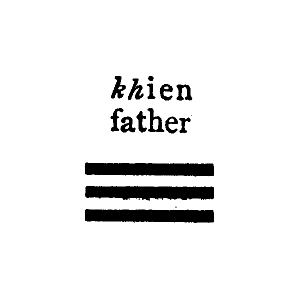

The Judgement
This hexagram speaks of a sudden and unexpected encounter: a single weak line appears at the bottom, beneath five strong lines, and wants to win them all over. The old text expresses this with the image of a bold and strong woman whom it would not be good to marry. Beyond the language of its time, the meaning is clear and applies to anyone: a small but intrusive element enters your life by chance, a seductive but unreliable person, a tempting proposal that hides risks, a temptation that appears when you least expect it, and if it is not recognised in time it grows, insinuates itself and ends up taking the place of what was good. It is not an invitation to paranoia, but to clarity: in this period something or someone is coming to meet you with great energy, and the right question is not whether you like it, but whether it is wise to bind yourself. The practical advice: do not commit right away to whoever appears suddenly, however charming; do not sign contracts offered with too much insistence; give time its time and watch how this novelty behaves once the initial enthusiasm passes. What is good withstands waiting; what is not reveals itself.
Source: James Legge, The Yî King (Sacred Books of the East, vol. XVI) (1882) · read the original passage
The Image
The image is the wind blowing beneath the sky: it penetrates everywhere, reaches every corner, and produces its effects. The sovereign, in accordance with this, delivers his charges and spreads his announcements to the four quarters of the kingdom. In everyday terms, it is the moment to communicate clearly and thoroughly: whoever holds responsibility, in the family or at work, must not let things be learned by hearsay. Rules, decisions, intentions must be told to everyone, openly, so that no one can take advantage of gaps in information. The advice: if you have made a decision that affects others, communicate it yourself, directly, before it arrives distorted.
Source: James Legge, The Yî King (Sacred Books of the East, vol. XVI) (1882) · read the original passage
The six lines
First line
The intrusive element must be kept tied and fastened, like a carriage held by a metal brake: in this way, with firm correctness, there will be good fortune. If instead it moves in any direction, harm appears: it is like a lean pig that will not stop jumping about. The meaning is that a small temptation, a newly born habit, a person beginning to insinuate themselves, must be checked at once, with restraints both inner and outer. The advice: set a clear limit now, before the thing gains momentum.
Source: James Legge, The Yî King (Sacred Books of the East, vol. XVI) (1882) · read the original passage
Second line
You have a wallet with a fish in it: the problematic element has come under your control, and there is no error. But the text warns that it will not be well to let it go forward to the guests, that is to allow it to reach the others. You are the person closest to the source of the disorder and it falls to you to contain it, without passing it on to those further away. If you are holding a delicate situation, an awkward piece of information, a difficult person, manage it yourself, with discretion, and do not let it circulate.
Source: James Legge, The Yî King (Sacred Books of the East, vol. XVI) (1882) · read the original passage
Third line
This line describes someone wounded in their pride who walks with difficulty: you have passed the centre, you have no support above and you are cut off from the element you would like to control. You are nervous, undecided, and the position is dangerous; but since your aim is the right one, keeping away what is harmful, there will be no great error. If you feel powerless before a situation you can neither stop nor reach, do not torment yourself: you are doing your part, and that is enough.
Source: James Legge, The Yî King (Sacred Books of the East, vol. XVI) (1882) · read the original passage
Fourth line
You have the wallet, but no fish in it: the person or thing you should have kept close has already gone to someone else, because you kept yourself aloof. This will give rise to trouble. The text attributes the loneliness of this line to its impatience and its detachment from people. If you notice you have lost touch with someone who mattered, a collaborator, a child, a friend, by neglecting them or treating them with condescension, do not wait any longer: draw near again with humility, while there is still time.
Source: James Legge, The Yî King (Sacred Books of the East, vol. XVI) (1882) · read the original passage
Fifth line
You are like a medlar tree whose crown overspreads the gourd growing beneath it: you have authority, position and qualities, and the small element is at your feet. But the text does not ask you to crush it by force: it asks you to keep your brilliant qualities concealed, not to show off, to wait for the right moment, and then a good outcome will descend as if from Heaven. If you are in the position of one who leads and you see something wrong growing, do not react on impulse: calmly prepare your plan, and act when it is ripe.
Source: James Legge, The Yî King (Sacred Books of the East, vol. XVI) (1882) · read the original passage
Sixth line
You receive others on your horns: you have reached the top, exhausted, and whoever approaches is pushed away harshly. There will be cause for regret, but no error. This is the line of someone who has withdrawn from the world: they do nothing to stop the advance of what is harmful, but at least they keep away from bad company. If you have chosen to isolate yourself to protect yourself, that is fine, but know that more was expected of you. The advice: soften the horns and remain at least reachable for those who care about you.