22. Grace
賁 · Bì · La Grazia · lines from the bottom: 101001
The two trigrams
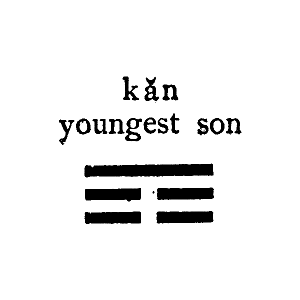
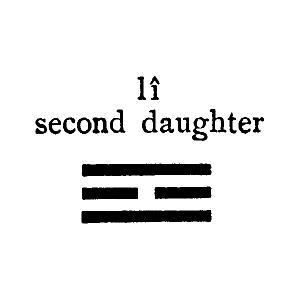
The Judgement
Grace is the hexagram of ornament, of the beauty added to things: the polished form, the elegant gesture, the well-said word. The text says all this should have free course, because as there is beauty in nature so there should be in life among people; but it adds at once that there will be little advantage if ornament is allowed to advance and take the lead. It means that form is precious as long as it stays in the service of substance. If these days you are tending to appearance, your own or a project's, a presentation, a home to fix up, a profile, an occasion where you want to make a good impression, this hexagram tells you that you are doing well, and that grace opens doors. But be careful not to let the packaging become more important than the contents: in love, do not mistake courtship for the bond; at work, do not present well what is not yet solid. The practical advice is to give appearance the time it deserves and not a minute more, and always to ask yourself, before showing something, whether it holds up even without the frame.
Source: James Legge, The Yî King (Sacred Books of the East, vol. XVI) (1882) · read the original passage
The Image
The image is that of fire burning at the foot of the mountain: the light rises and sets trees, grasses, everything in beauty. The wise person, the text says, throws brilliance around the many ordinary processes of government, but does not dare to decide criminal cases in the same way. It means there is a field for elegance and one where only the bare truth serves. If you deal in communication, hospitality, relationships, use the touch that embellishes by all means; but when you must judge a fault, divide an inheritance, establish who is wrong, strip away every ornament. The practical advice: in serious matters, speak plainly and go to the facts.
Source: James Legge, The Yî King (Sacred Books of the East, vol. XVI) (1882) · read the original passage
The six lines
First line
The first line shows someone adorning their feet, that is, their way of walking, and able to give up the carriage to go on foot. It is the portrait of someone at the bottom, without a role yet, who tends to themselves with dignity: they need no luxuries to feel in order. If you are at the start of a path, the advice is to focus on the substance of your behaviour, punctuality, correctness, the way you treat others, and to let go of the status symbols you cannot afford. Walking on your own legs is already an ornament.
Source: James Legge, The Yî King (Sacred Books of the East, vol. XVI) (1882) · read the original passage
Second line
The second line shows someone adorning their beard. The beard does not move by itself: it follows the chin. It is the image of someone tending a detail that depends on something else, and it reminds us that ornament always goes together with what supports it. If you are in a position where you depend on another person, a boss, a partner, a stronger associate, the advice is to move in accord with them and not to expect to shine on your own account. Make a good impression together with the one who holds you up, not against them.
Source: James Legge, The Yî King (Sacred Books of the East, vol. XVI) (1882) · read the original passage
Third line
The third line shows someone looking adorned and bedewed with rich favours: everything around them embellishes and flatters them. But the text warns: always keep your firmness, and then fortune will be good. It is the period when everything smiles on you, in love, among friends, at work, and the temptation is to sink into this sweetness. Be careful: other people's attentions depend on circumstances, they are not a possession. The advice is to enjoy the favours without losing your head, and to remain the person you were before they arrived.
Source: James Legge, The Yî King (Sacred Books of the East, vol. XVI) (1882) · read the original passage
Fourth line
The fourth line shows someone who looks adorned but only in white, as if on a winged white horse, seeking union with the one meant for them while the one in between is not a robber but someone intent on an honest bond. It is a complicated image that says something simple: between you and the person or goal you seek there is an obstacle, and you wonder whether that obstacle is an enemy. The text reassures you: it is not. If you feel suspicious of whoever has come between you and what you desire, the advice is to stay faithful to your purpose, but not to ascribe bad intentions to someone who may simply have their own reasons. The union will come, sober and without frills.
Source: James Legge, The Yî King (Sacred Books of the East, vol. XVI) (1882) · read the original passage
Fifth line
The fifth line shows someone adorned by the occupants of the heights and gardens, carrying their roll of silk, small and slight: they may look stingy, but in the end fortune will be good. It is the position of someone with an important role but limited means, who receives their dignity from the surroundings and the people around them more than from what they own. If you find yourself giving a gift, an offering, a welcome with less than you would like, do not be ashamed of it: in ceremonies, the commentary says, it is better to be sparing than extravagant. The advice is to give sincerely what you have, without apologising.
Source: James Legge, The Yî King (Sacred Books of the East, vol. XVI) (1882) · read the original passage
Sixth line
The sixth line shows someone with white as their only ornament: no error. We are at the top of the hexagram, ornament has run its course and there is a return to pure simplicity. It is the portrait of someone who no longer needs to prove anything: substance counts for more than decoration. If you have spent a period tending to image, home, career, appearances, and feel the wish to strip away the superfluous, this line tells you it is the right road. The practical advice: simplify, remove what serves only to impress, and let the facts speak for you.