2. The Receptive
坤 · kūn · Il Ricettivo · lines from the bottom: 000000
The two trigrams
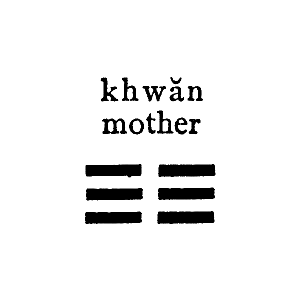
The Judgement
The Receptive has the same four qualities as the Creative, great and originating, penetrating, advantageous, correct, but its firmness is that of a mare: docile, strong, able to carry a load and follow a direction. The Judgment speaks to you plainly: if you have to move right now, do not take the initiative, because you risk going astray; if instead you follow, you will find the proper lord, the person or the project you can entrust yourself to. The advantage, Legge says, lies in getting friends in the south-west and losing friends in the north-east: in your life, that means seeking those who share your way of feeling, and accepting to let go of those who pull the other way. If you feel you are in the second row, do not take it as a defeat: it is your strength for now. Practical advice: in a negotiation or a decision as a couple, let the other person make the first move, and accompany it with constancy. If you rest in correctness and firmness, there will be good fortune.
Source: James Legge, The Yî King (Sacred Books of the East, vol. XVI) (1882) · read the original passage
The Image
The Image is the earth, with its capacity to bear and sustain all things. The wise person, Legge says, with his large virtue supports people and things. For you it is a concrete invitation: right now your strength lies not in commanding but in carrying. Support those beside you, a child, a struggling colleague, a friend going through a dark stretch. Do it generously, without keeping score. The earth asks nothing of what grows on it, and that is exactly why everything comes back to it. Advice: today, offer help before anyone asks for it.
Source: James Legge, The Yî King (Sacred Books of the East, vol. XVI) (1882) · read the original passage
The six lines
First line
First line: you are treading on hoarfrost, and the strong ice will come by and by. This line tells you to read the small signs. A delay that keeps repeating, a silence at home, an expense slipping through: that is the frost, and the freeze comes later. Do not panic, but do not pretend nothing is happening. Take note now, deal with it while it is still light, and the ice will not catch you off guard.
Source: James Legge, The Yî King (Sacred Books of the East, vol. XVI) (1882) · read the original passage
Second line
Second line: the attribute of being straight, square, and great; its operation, without repeated efforts, is advantageous in every respect. This is a line of deep serenity: when you are honest and straightforward, things move on their own, you do not have to redo the same job three times. If you are wondering whether you need a complicated strategy, the answer is no. Be simple, clear, consistent, and let your integrity speak for you.
Source: James Legge, The Yî King (Sacred Books of the East, vol. XVI) (1882) · read the original passage
Third line
Third line: you keep your excellence under restraint, but firmly maintain it. If you happen to be in the king's service, you will not claim the success for yourself, and yet you will bring affairs to a good issue. This is the line of those who work well without needing applause. If at work or at home you feel the credit goes to others, that is no accident: your quality shows in the results. Keep going, and hold quietly on to the knowledge of your worth.
Source: James Legge, The Yî King (Sacred Books of the East, vol. XVI) (1882) · read the original passage
Fourth line
Fourth line: a sack tied up; there will be no ground for blame or for praise. This is a time when it pays to close up a little, to keep plans and opinions to yourself. Nobody will criticise you, nobody will praise you, and that is fine. If you feel invisible, know that it is a protection: through carefulness, the commentary says, no injury will be received. Advice: postpone confidences and public statements to a more favourable moment.
Source: James Legge, The Yî King (Sacred Books of the East, vol. XVI) (1882) · read the original passage
Fifth line
Fifth line: the yellow lower garment, and there will be great good fortune. Yellow is the colour of the earth and of the centre, and the lower garment is a symbol of humility. You hold a prominent position, perhaps you have become a point of reference for others, and the good fortune comes precisely if you remain simple and measured. Do not show off, do not raise your voice, keep a sober profile: that is how your place of honour becomes a blessing for everyone.
Source: James Legge, The Yî King (Sacred Books of the East, vol. XVI) (1882) · read the original passage
Sixth line
Sixth line: dragons fighting in the wild, and their blood is purple and yellow. This is the warning of the topmost line: whoever was born to support, and has pushed his own course to the extreme, ends up clashing with the very power he was meant to accompany, and both come out damaged. If you are turning a partnership into a war, as a couple or at work, stop: a fight to the bitter end leaves marks on both sides. Take a step back before the price goes up.
Source: James Legge, The Yî King (Sacred Books of the East, vol. XVI) (1882) · read the original passage
When all the lines change
Here too the seventh paragraph speaks only when all six lines change: the whole earth, six sixes, turns into heaven. Legge is dry: if those represented by these lines remain perpetually correct and firm, advantage will arise. For you it means that the moment of greatest receptiveness, when you have said yes to everything and everyone, is about to turn into a phase of initiative; and the one thing that protects you in the passage is consistency. Do not change your principles while the scene changes: keep your word, your schedules, your small promises. Whoever stays faithful to themselves while everything around them transforms finds, at the end of the turn, that the transformation works in their favour.