30. The Clinging (Fire)
離 · Lí · L'Aderente (Il Fuoco) · lines from the bottom: 101101
The two trigrams
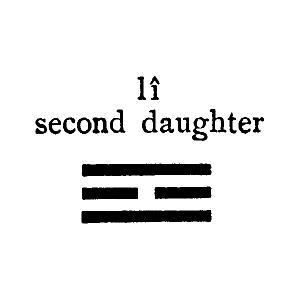
The Judgement
The Clinging is the sign of fire repeated, of light and the sun: the clarity of intelligence, but also the idea of adhering, of depending, because fire lives only attached to what it burns. The text tells you it will be advantageous to be firm and correct, and that thus there will be free course and success; then it adds an unusual instruction: nourish the docility of the cow, and there will be good fortune. It is no accident that this hexagram reaches you at a moment when you feel brilliant, capable, clear-headed, perhaps a little too sure. Light needs something to hold on to: your intelligence needs people, rules, bonds that keep it grounded, otherwise it flares up and consumes. If you hold a visible position, a role in which others watch you, a relationship in which you are the one who decides, the practical advice is to join to your clarity a true gentleness: listen to whoever contradicts you, accept depending on those who support you, do not use your light to dazzle. The docility the text speaks of is not weakness, it is the ability to stay attached to what is right and follow it calmly, like the flame that clings to the wood. That way your light lasts, and lights others too.
Source: James Legge, The Yî King (Sacred Books of the East, vol. XVI) (1882) · read the original passage
The Image
The image is that of brightness repeated: the sun rising one day after another. The great person, the text says, cultivates their brilliant virtue more and more and diffuses its brightness over the four quarters of the land. It is not a light switched on once, but a clarity to be fed every day and shared. If you have a talent, a skill, an ability to see things that others lack, do not keep it to yourself and do not let it rust. The practical advice is to study a little every day, to explain to others what you understand, to bring clarity where there is confusion, in the family, at work, among friends. Light grows only if you let it circulate.
Source: James Legge, The Yî King (Sacred Books of the East, vol. XVI) (1882) · read the original passage
The six lines
First line
The first line shows someone ready to move with confused steps, but at the same time treading with respect: there will be no mistake. It is the energy of a fire just lit, which wants to rise at once and risks doing so clumsily and impetuously. If you are starting something, a job, a relationship, a day full of commitments, and feel agitated, in a hurry to do everything right away, the advice is not to put out the enthusiasm but to give it a shape: slow down, pay attention to each step, treat with regard the people and things you meet. Fire that respects what it touches does no damage.
Source: James Legge, The Yî King (Sacred Books of the East, vol. XVI) (1882) · read the original passage
Second line
The second line shows someone in their place dressed in yellow: great good fortune. Yellow is the colour of the centre and of measure, and this is the happiest line of the hexagram: light that does not dazzle, clarity that stays balanced and needs no excess. If you find yourself in a central position, in the family, in a group, in an organisation, and wonder how to behave, this line tells you to stay faithful to the middle way: no dramas, no ruptures, no showy gestures. The advice is to keep doing well what you are doing, warmly and without exaggeration: fortune is already here.
Source: James Legge, The Yî King (Sacred Books of the East, vol. XVI) (1882) · read the original passage
Third line
The third line shows someone in the position of the setting sun: instead of playing their earthenware instrument and singing to it, they utter the groans of an old man of eighty. There will be evil. It is the person who, having reached the end of a phase, a job, an age, a role, cannot accept it and consumes themselves in regret. The text does not ask you to feign cheerfulness, but not to turn a natural passage into a tragedy. If you are living through an ending, the advice is to let go serenely, to allow yourself the small pleasures the moment permits, and not to poison those close to you with constant complaining.
Source: James Legge, The Yî King (Sacred Books of the East, vol. XVI) (1882) · read the original passage
Fourth line
The fourth line shows the manner of someone's coming: how abrupt it is, like a sudden fire, like death, and for that reason rejected by all. It is the portrait of someone who enters a situation with too much force, without tact, and in an instant burns up the trust they could have built. No one can bear them. If you recognise yourself in someone who bursts into conversations, imposes their ideas, arrives in a new environment expecting to change everything at once, be careful: that is how you isolate yourself. The advice is to moderate your entrance, observe before intervening, and let others get used to your light little by little.
Source: James Legge, The Yî King (Sacred Books of the East, vol. XVI) (1882) · read the original passage
Fifth line
The fifth line shows someone with tears flowing in torrents and groaning in sorrow: there will be good fortune. It looks like a paradox, but it is not: this is the position of someone who holds responsibility, is squeezed between forces bigger than themselves, and instead of pretending to be invulnerable acknowledges their own anxiety and fragility. Precisely this humility, the commentary says, is the proof of their adherence to what is right. If these days you find yourself weeping for the weight you carry, do not be ashamed of it: it is a sign of heart, not of weakness. The advice is to let the pain out with those who care for you, and to go on without harshness towards yourself.
Source: James Legge, The Yî King (Sacred Books of the East, vol. XVI) (1882) · read the original passage
Sixth line
The sixth line shows the king employing someone in his punitive expeditions: that person achieves admirable merit, strikes only the chiefs of the rebels, and does not punish the prisoners who were not their accomplices. There will be no error. It is the position of one who has the highest clarity and the strength to enforce justice, but uses it with discernment: striking at the root of the problem and sparing those who were dragged into it. If you must put an end to an abuse, a toxic situation, an unacceptable behaviour, at home or at work, the advice is to go after the real cause and not after those who merely followed. Generous firmness leaves no grudges.