10. Treading
履 · lǚ · Il Procedere · lines from the bottom: 110111
The two trigrams
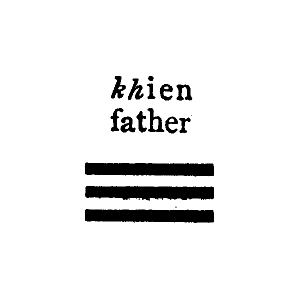

The Judgement
The image of this hexagram is among the most vivid in the whole book: someone treads on the tail of a tiger, and the tiger does not bite him. There will be progress and success. The name means treading, walking, conduct: the way you move among people and situations more powerful than yourself. If right now you are dealing with a difficult boss, an institution, a person of strong character, or simply moving in an environment where one false step costs dearly, this is your situation. The good news is that it can be done: the tiger does not bite the one who walks with grace. The secret, the commentators say, is propriety, respect for the rules of courtesy, the ability to keep your place without servility and without arrogance. It is no accident if you feel a little tense: it is the right kind of tension, the kind that keeps you awake. Practical advice: in every delicate encounter these days, be impeccable in your manners, punctual, clear, kind, and never provoke; that way you will get through, and come out stronger.
Source: James Legge, The Yî King (Sacred Books of the East, vol. XVI) (1882) · read the original passage
The Image
The Image is the sky above and beneath it the waters of a marsh: each in its place, according to nature. The wise person, Legge says, in accordance with this, discriminates between high and low and gives settlement to the aims of the people. This is not praise of rigid hierarchies, but a practical observation: a community, a company, a family work when everyone knows what their role is and what they can expect. If confusion of roles reigns around you, you are the one who can bring clarity. Advice: settle with those who work or live with you who does what, and the anxieties will subside.
Source: James Legge, The Yî King (Sacred Books of the East, vol. XVI) (1882) · read the original passage
The six lines
First line
First line: you tread your accustomed path; if you go forward, there will be no error. You are at the beginning, with energy and integrity, and no obligations yet condition you. The commentary says that singly and exclusively you carry out your long-cherished wishes. If you are wondering whether you should change your style to be accepted, the answer is no: carry on simply, as you always have. Advice: go forward at your own pace, without imitating anyone.
Source: James Legge, The Yî King (Sacred Books of the East, vol. XVI) (1882) · read the original passage
Second line
Second line: you tread the path that is level and easy, a quiet and solitary man to whom, if he is firm and correct, good fortune will come. You have no great ally above, and that is fine: your road is comfortable because you seek neither clashes nor favours. If these days you feel somewhat on the sidelines, without powerful backers, that is not a problem. The commentary says that holding the due mean, you will not allow yourself to be thrown into disorder. Advice: nurture your calm and do not get dragged into other people's agitation.
Source: James Legge, The Yî King (Sacred Books of the East, vol. XVI) (1882) · read the original passage
Third line
Third line: a one-eyed man who thinks he can see; a lame man who thinks he can walk well; one who treads on the tail of a tiger and is bitten. All this indicates ill fortune: a mere bravo acting the part of a great ruler. This is the sternest warning in the hexagram. If you are throwing yourself into a situation bigger than you, convinced that grit alone will carry you, stop: will-power does not replace ability. The commentary says your aims are too violent. Advice: assess your limits honestly before challenging someone stronger.
Source: James Legge, The Yî King (Sacred Books of the East, vol. XVI) (1882) · read the original passage
Fourth line
Fourth line: you tread on the tail of a tiger, but you become full of apprehensive caution, and in the end there will be good fortune. You are very close to power, right beside the one in command, in a delicate position. The whole difference from the previous line lies here: you are afraid, and fear makes you prudent. If you are facing an exam, an interview, a negotiation with someone far stronger, the apprehension you feel is an ally. The commentary says your aim takes effect. Advice: go softly, with respect, and you will get there.
Source: James Legge, The Yî King (Sacred Books of the East, vol. XVI) (1882) · read the original passage
Fifth line
Fifth line: the resolute tread of someone in the position of command. Though he is firm and correct, there will be peril. You are high up, with strength and reason on your side, and precisely because of that you are at risk: the higher you stand, the harder the fall can be. The commentary recalls that the most excellent thing in propriety is humility. If you lead people, take important decisions, carry responsibility for others, do not let confidence harden into rigidity. Advice: decide firmly, but first listen to those who see it differently.
Source: James Legge, The Yî King (Sacred Books of the East, vol. XVI) (1882) · read the original passage
Sixth line
Sixth line: look at the whole course that has been trodden and examine the presage it gives. If it is complete and without failure, there will be great good fortune. This is the moment of reckoning: you have come to the end of a road, a year of work, a stage of life, a relationship that has weathered its trials, and you can turn round and look. If every step was right and consistent, the outcome will be excellent, and the commentary calls it great matter for congratulation. Advice: set aside an evening to review honestly what you have done, and acknowledge your own merit.